Skip to content
What Lubricants Are Best for Maintaining a Tractor?

There is no single lubricant that is best for every part of a tractor. Manufacturer guidance separates engine, transmission, hydraulic, axle, gear, and grease applications because each component can have a different requirement.
The best lubricant is the product that:
- Is intended for the exact component or shared reservoir.
- Has the manufacturer-required viscosity.
- Meets the required performance specification.
- Suits the expected temperature range and operating duty.
- Has current, traceable technical documentation.
- Is used with the correct quantity, filter, service interval, and level-check procedure.
The operator’s manual and the latest model-specific information from the original equipment manufacturer (OEM) take priority over brand familiarity, colour, price, or a generic “tractor oil” label. This specification-first approach also provides a reliable way to assess locally available products in Latin America and Africa without assuming that similar packaging or viscosity means equivalent performance.
How Should You Choose a Tractor Lubricant?
Start with the exact tractor, component, shared-reservoir arrangement, OEM specification, viscosity, temperature range, and service procedure—not a generic product label.
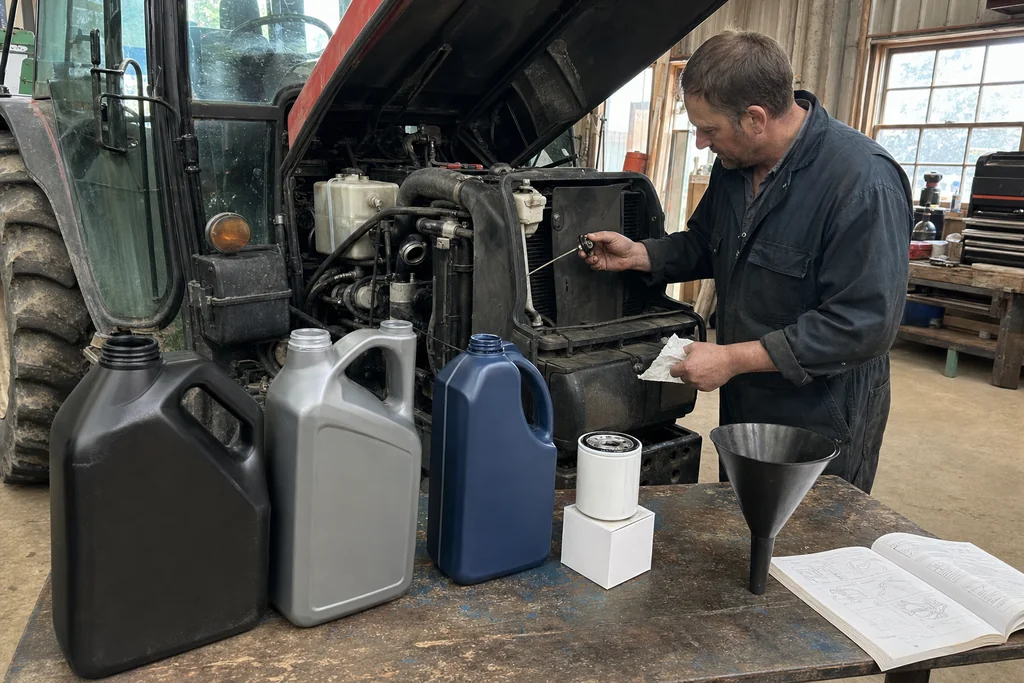
Use this sequence before buying, topping up, or changing a lubricant:
-
Identify the tractor accurately. Record the make, model, serial number or product identification number (PIN) range, approximate year, engine model, transmission type, and emissions configuration where available.
-
Identify the exact service point. Determine whether the lubricant is for the engine, transmission, hydraulic system, front axle, differential, final drive, gearbox, power take-off (PTO) housing, wheel hub, bearing, pin, bushing, universal joint, or another point. Manufacturer tables demonstrate why these component requirements remain separate1.
-
Confirm the reservoir arrangement. Establish whether the transmission, hydraulic system, steering, wet brakes, wet clutches, PTO controls, differential, or final drives share one sump. Do not assume that two tractors from the same manufacturer use the same arrangement.
-
Copy the complete requirement. Record the fluid family, OEM specification, performance category, viscosity grade, grease consistency grade, and temperature restrictions. A viscosity number alone is incomplete.
-
Check temperature and duty. Use the manufacturer’s temperature chart. Consider the actual minimum and maximum ambient temperatures, cold starts, sustained loads, intensive hydraulic work, dust, water exposure, seasonal operation, and storage periods.
-
Verify the product’s exact written claim. Consult a current product data sheet and distinguish among “OEM approved or licensed,” “listed by the OEM,” “meets the requirements of,” “recommended for,” and “suitable for use in.” These statements are not automatically equivalent. Manufacturer lubrication guides connect products to documented application specifications2; a supplier’s compatibility statement should not be rewritten as formal approval.
-
Confirm the service procedure. Check capacity, drain points, filters, suction screens, breathers, filling stages, level-check conditions, change interval, and any approved changeover procedure. Follow the manual because these details and intervals are specific to the tractor3.
If any part of this chain is missing, obtain clarification from the OEM, component manufacturer, qualified dealer, or lubricant supplier before proceeding.
Key takeaway: Choose a lubricant only after the complete model-specific requirement and the product’s exact written claim have been verified.
Which Lubricant Belongs in Each Tractor Component?
Engine oil, transmission-hydraulic fluid, separate hydraulic oil, axle or gear oil, grease, and specialty products serve different components and cannot be treated as interchangeable.
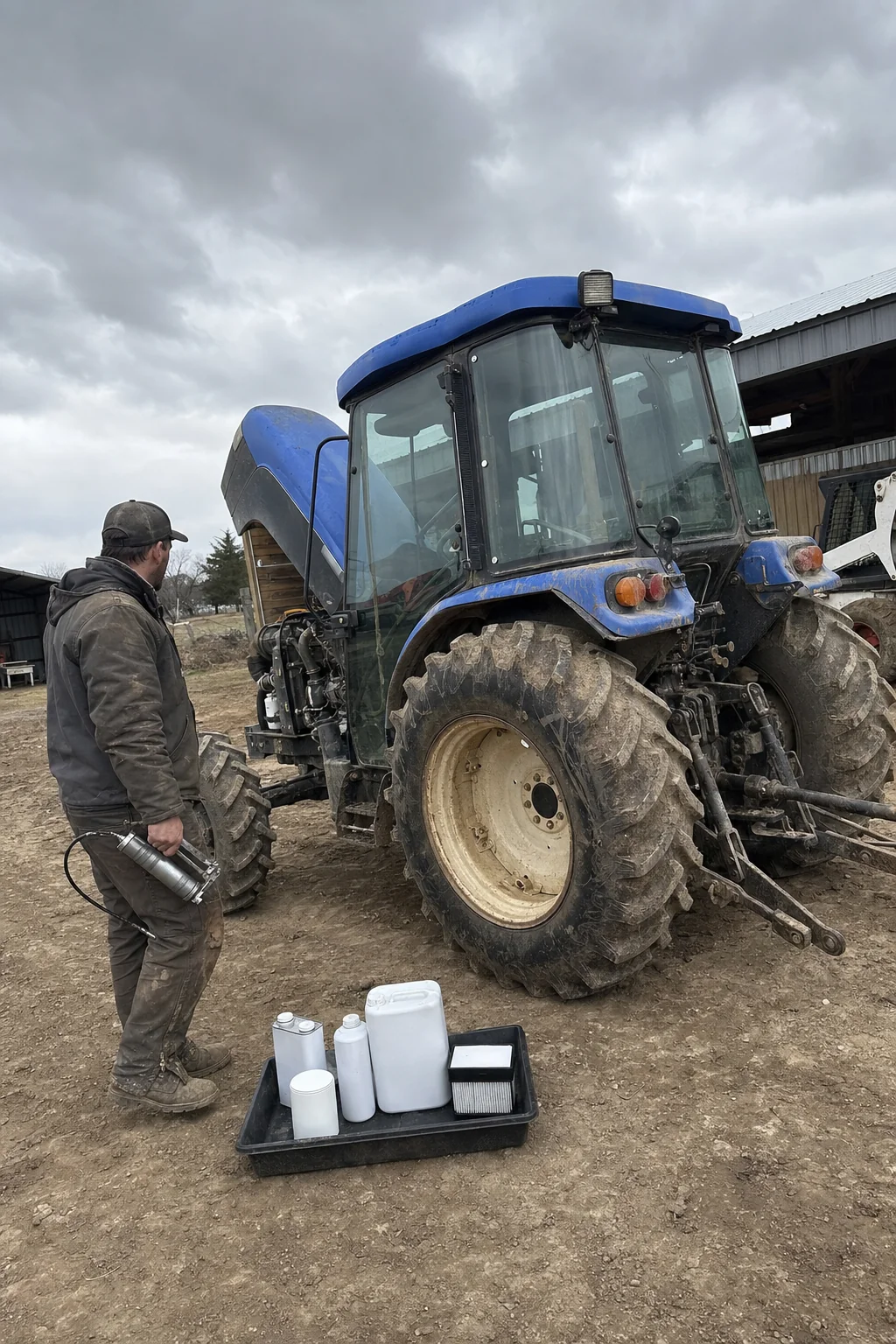
Manufacturer maintenance guidance assigns different lubricant families by application1. Use these component cards as a guide, not as a substitute for the tractor manual.
Diesel engine
Use and verify: Diesel engine oil with the required SAE viscosity and American Petroleum Institute (API), European Automobile Manufacturers’ Association (ACEA), or OEM performance category. Verify aftertreatment compatibility, fuel-related restrictions, and the approved interval.
Common mistake: Buying oil only because it says “diesel,” “heavy duty,” or shows a familiar SAE grade.
Combined transmission-hydraulic system
Use and verify: The exact OEM tractor transmission-hydraulic specification—often supplied by a Universal Tractor Transmission Oil (UTTO), but controlled by the written OEM requirement. It may serve gears, pumps, valves, steering, PTO controls, wet brakes, and wet clutches.
Common mistake: Substituting ordinary hydraulic oil, automatic-transmission fluid, engine oil, or automotive gear oil because its apparent viscosity seems similar.
Separate hydraulic reservoir
Use and verify: The specified hydraulic-fluid type, performance classification, OEM requirement, and International Organization for Standardization viscosity grade (ISO VG) for the operating temperature.
Common mistake: Selecting only by ISO VG; the grade does not establish anti-wear performance, low-temperature response, oxidation resistance, or seal compatibility.
Axles, differentials, final drives, gearboxes, and hubs
Use and verify: The required SAE gear-oil grade plus the API gear service designation or OEM specification. Use a multifunction tractor fluid only where the manual permits it.
API designations cover different gear-lubricant services4, so one designation should not be assumed to replace another.
Common mistake: Filling every axle, hub, gearbox, and final drive with the same oil.
Pins, bushings, bearings, universal joints, and linkages
Use and verify: The specified grease type and National Lubricating Grease Institute (NLGI) consistency grade. Also verify base-oil viscosity, thickener, load performance, water resistance, temperature capability, and compatibility.
Common mistake: Assuming every grease fitting needs the same NLGI 2 multipurpose grease.
Special service points
Use and verify: Chain oils, cable lubricants, dry-film products, anti-seize compounds, penetrating oils, or protective sprays only where expressly permitted.
Common mistake: Treating a specialty product as a substitute for engine oil, hydraulic fluid, gear oil, transmission fluid, or grease.
Some bearings and joints are sealed or lubricated for life. Do not add grease unless the manual identifies a service point. For serviceable points, NLGI guidance distinguishes consistency from other grease properties5, so the NLGI number is only one part of the selection.
The safest final check is to compare the component entry in the operator’s manual with the proposed product’s current data sheet. A manufacturer manual may assign different oils and intervals3 within the same tractor.
Why Are Viscosity and Performance Specifications Different?
SAE and ISO viscosity grades describe flow behaviour within defined tests; API, ACEA, OEM, hydraulic, and gear classifications address separate performance requirements.

Viscosity describes resistance to flow under defined test conditions. A performance specification addresses a broader set of operating requirements. A tractor lubricant must match both.
-
Engine-oil viscosity: An SAE grade describes tested low- and high-temperature flow behaviour. Two oils carrying the same grade can have different additive systems, performance categories, OEM approvals, soot control, oxidation resistance, and aftertreatment compatibility.
-
Hydraulic-oil viscosity: ISO VG identifies a viscosity class. It does not independently prove anti-wear protection, viscosity stability across temperature changes, air release, filterability, seal compatibility, or suitability for a particular hydraulic system.
-
Engine-oil performance: API, ACEA, and OEM categories are separate from SAE viscosity. API states that CK-4 exceeds the performance criteria of several earlier diesel categories, but the engine manufacturer still controls suitability, fuel restrictions, and the interval. The API also states that FA-4 is not backward compatible6 with CK-4 and several earlier categories. Do not use FA-4 in a tractor unless the engine manufacturer expressly approves it.
-
Gear-oil performance: An SAE gear-oil viscosity and an API or OEM gear performance designation answer different questions. Matching the viscosity does not prove that the oil provides the required protection or material compatibility.
-
Synthetic versus mineral: A suitable synthetic or synthetic-blend oil may provide useful cold-flow, volatility, oxidation, or temperature characteristics. However, “synthetic” does not prove that the viscosity, performance category, additive chemistry, aftertreatment compatibility, or OEM approval is correct. It also does not automatically authorise a longer drain interval.
Approve a product only when the required viscosity and every controlling performance specification appear in its current technical documentation.
API FA-4 diesel engine oil is backward compatible with CK-4 and earlier categories.False
API states that FA-4 is not interchangeable or backward compatible with CK-4 and several earlier diesel categories. Use it only when the engine manufacturer permits it.
Greases with the same NLGI grade can always be mixed safely.False
NLGI grade describes consistency, not the complete formulation or compatibility. Different greases can interact adversely and should not be mixed without verification.
One lubricant family can be assumed suitable for every tractor compartment.False
Manufacturer guidance assigns separate requirements to engines, transmissions, hydraulic systems, axles, gears, and grease points; the correct product depends on the specific application.
Key takeaway: Approve a product only when both its viscosity and its required performance specification match the tractor manufacturer’s instruction.
Why Are UTTO and STOU Choices Compatibility-Critical?
A shared tractor reservoir may serve gears, pumps, wet brakes, wet clutches, steering, and PTO controls, so the exact OEM fluid specification controls the decision.
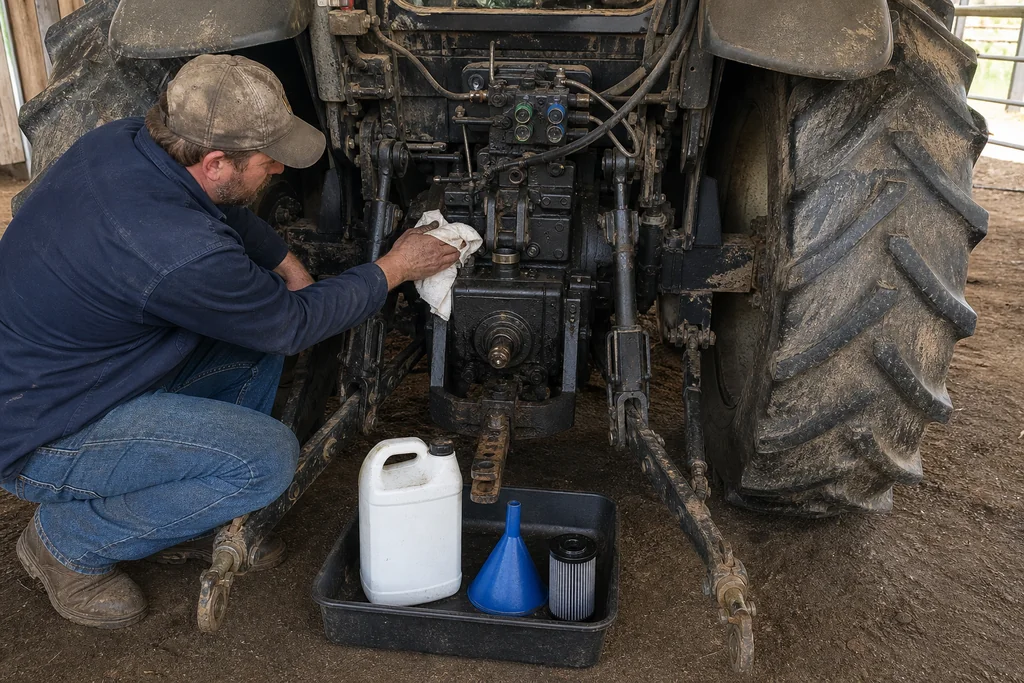
Universal Tractor Transmission Oil (UTTO) is intended for certain tractor transmission, hydraulic, and related shared-sump applications. However, UTTO is a product-family description—not one universal cross-brand performance standard. A manufacturer may prescribe an exact transmission-hydraulic specification7 and warn against mixing oils.
A compliant shared-reservoir fluid may need to balance:
- Wet-brake friction and chatter control.
- Wet-clutch engagement and slip behaviour.
- Gear, bearing, and hydraulic-pump protection.
- Powershift or continuously variable transmission operation.
- Low-temperature response and shear stability.
- Oxidation control, air release, and foam resistance.
- Seal, hose, filter, and deposit compatibility.
Super Tractor Oil Universal (STOU) may carry claims for engines, transmissions, hydraulics, or other tractor applications. Its name does not prove suitability for every claimed use. Each application must independently match the required viscosity and performance specification.
Therefore:
- Ordinary hydraulic oil is not an automatic UTTO substitute.
- Automotive automatic-transmission fluid is not an automatic tractor-transmission substitute.
- Hypoid gear oil is not an automatic shared-sump substitute.
- Engine oil belongs in a transmission or hydraulic system only when the manufacturer expressly permits it.
- A low-viscosity version should not replace the standard fluid without model- and temperature-specific permission.
- Biodegradable or environmentally acceptable fluid needs separate compatibility verification.
- Terms such as zinc-free, ashless, or low-SAPS describe formulation characteristics; they do not prove complete compatibility.
- Friction modifiers, anti-chatter treatments, viscosity improvers, and other aftermarket additives should not be introduced without an OEM procedure.
The tractor manual remains the controlling document because it separates model-specific oils and restrictions3. When an implement circulates the tractor’s hydraulic fluid, also identify any fluid already held in the implement before connection or changeover.
How Should You Handle Older Tractors and Unknown Fluids?
Use the original manual, current OEM supersessions, component-manufacturer information, and traceable service records before changing or topping up an older tractor.
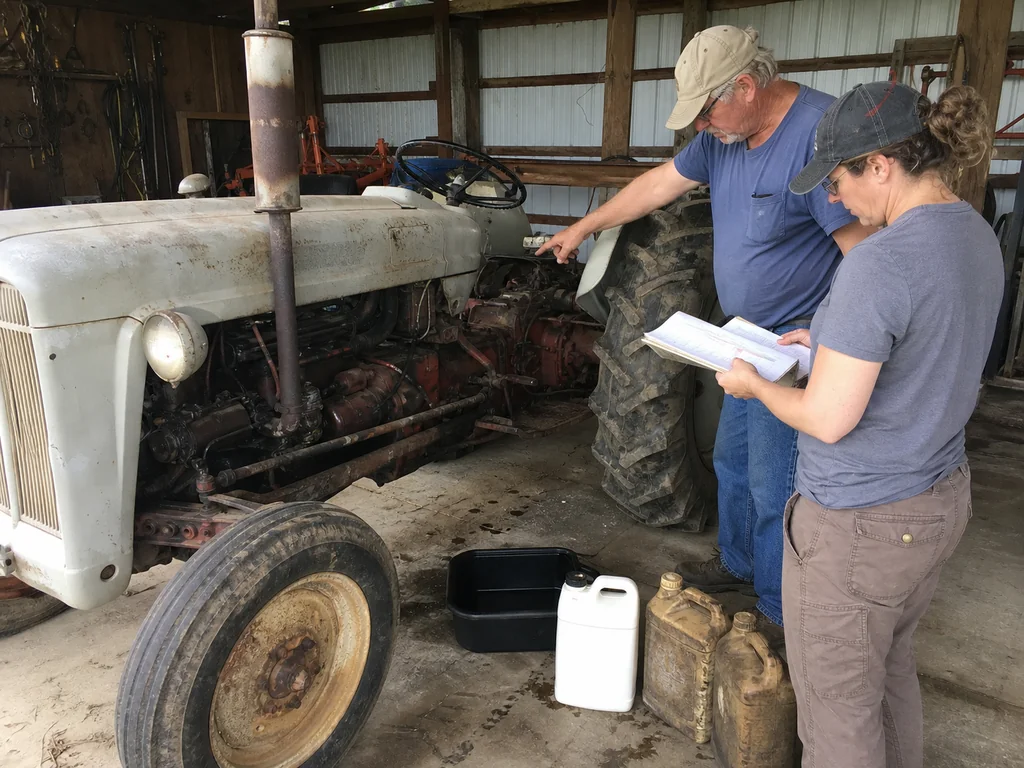
The newest lubricant is not automatically correct for an older tractor. Some later categories are backward compatible; others are not. Establish the requirement through this evidence chain:
- Use the original manual to identify the compartments, shared-reservoir arrangement, and original specification.
- Check current OEM service information for an approved supersession or revised recommendation.
- Consult the engine, transmission, or axle manufacturer if that component was supplied separately.
- Ask a qualified dealer or technical lubricant supplier when an obsolete specification cannot be mapped confidently.
Particular care is needed when the manual specifies a monograde engine oil, an obsolete diesel category, a dedicated wet-brake or wet-clutch fluid, a separate hydraulic oil, an older gear service designation, or an unusual grease. Manufacturer information demonstrates that requirements remain application and model dependent1.
If the existing fluid is unknown:
- Do not identify it by colour, smell, or the last product used for topping up.
- Review maintenance records, invoices, container labels, and previous supplier information.
- Avoid blind mixing and do not assume that a partial refill is harmless.
- Obtain an approved changeover procedure before draining or flushing.
A valid changeover might require draining more than one compartment, changing filters, cleaning screens, purging lines, addressing fluid held by an implement, or using a shortened initial interval. These steps should be followed only when specified by the equipment or lubricant supplier; do not invent a flushing procedure.
A lubricant change should not be used to hide leakage, overheating, low pressure, brake chatter, clutch slip, abnormal noise, metal debris, weak hydraulic response, or repeated fluid loss. These are reasons to inspect the machine and verify the existing lubricant. Model manuals provide the relevant service and mixing instructions3, but mechanical symptoms may also require a qualified technician.
How Should You Select and Change Tractor Grease?
NLGI consistency, base-oil viscosity, thickener chemistry, additives, water resistance, temperature capability, and application speed or load are separate selection factors.
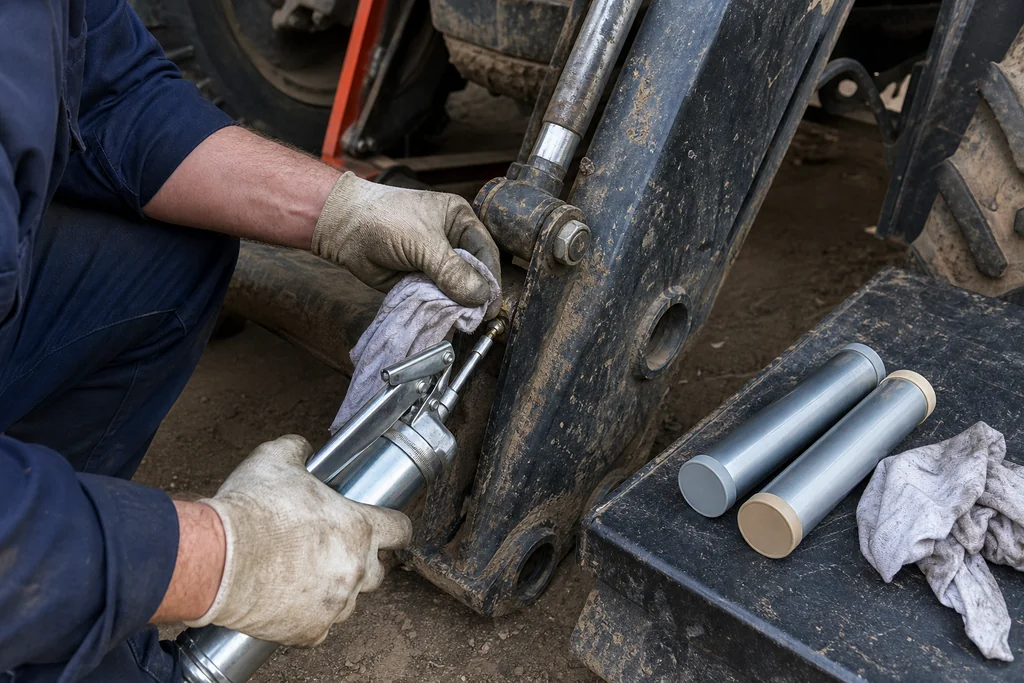
An NLGI grade describes grease consistency. It does not, by itself, establish load capacity, base-oil viscosity, water resistance, temperature stability, seal compatibility, or suitability for a particular speed. NLGI guidance specifically distinguishes grease consistency and base-oil viscosity5.
For each lubrication point, verify:
- The required NLGI consistency grade.
- Base-oil viscosity.
- Thickener chemistry.
- Extreme-pressure (EP) or anti-wear performance.
- Water and corrosion resistance.
- Low- and high-temperature capability.
- Solid-lubricant content, where specified.
- Seal compatibility and any OEM service classification.
- The correct amount and relubrication interval.
A grease for a slow, heavily loaded loader pin may not be suitable for a high-speed bearing or wheel hub. EP or molybdenum-disulfide grease can be appropriate for some pins, bushings, splines, or sliding contacts, but only where the OEM permits it. Do not infer the chemistry or compatibility of grease from its colour.
Do not mix different greases casually. Thickener, base oil, and additive interactions can produce excessive softening, hardening, leakage, or poor flow. If the existing grease is unknown:
- Consult the equipment manufacturer and both grease suppliers.
- Treat compatibility charts as preliminary screening rather than proof.
- Follow the approved changeover method, which may involve controlled purging or disassembly and cleaning.
- Use temporarily shorter relubrication intervals only when the procedure requires them.
- Monitor for heat, noise, leakage, poor grease flow, or a major consistency change.
Finally, apply the specified quantity. Do not force grease past a seal unless purging through that point is part of the manufacturer’s procedure.
Key takeaway: Use the grease required for the specific point and follow an approved changeover procedure when compatibility with the existing grease is uncertain.
How Do You Control Contamination and Judge Lubricant Condition?
Clean storage and transfer practices, correct filters, accurate service records, model-specific intervals, and condition trends matter as much as the product selected.
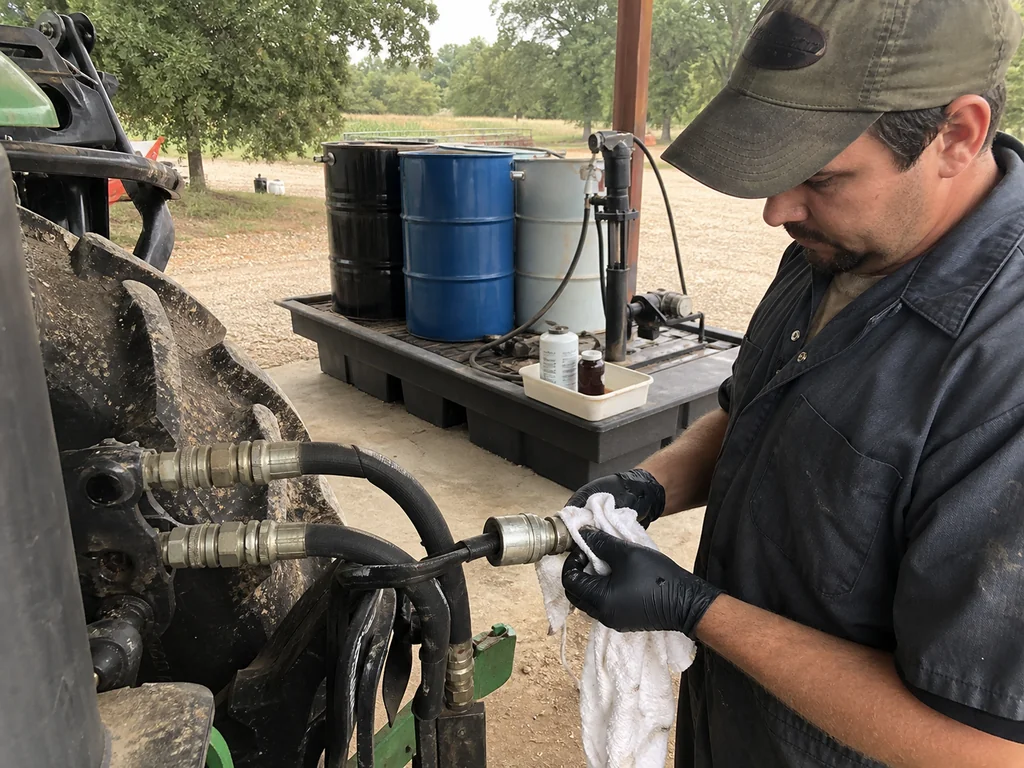
Even the correct lubricant can perform poorly when water, dirt, fuel, coolant, solvent, or an incompatible product enters the system. Good contamination control begins before the container reaches the tractor.
Storage and transfer
- Keep drums, pails, cartridges, and smaller containers closed and clearly labelled.
- Protect stock from rain, dust, condensation, and extreme heat.
- Clean fill caps, breathers, grease fittings, remote couplers, funnels, pumps, and transfer hoses before use.
- Use dedicated or clearly labelled transfer equipment where practical.
- Avoid open containers and dirty funnels.
- Clean implement couplers and consider fluid transfer when an implement circulates tractor hydraulic oil.
NLGI guidance covers grease storage and contamination concerns5, while tractor manuals address oil storage, filters, and mixing within the relevant service procedure.
Filters, levels, and intervals
Use the correct filter specification—not merely a filter of similar physical size. Replace filters, screens, and breathers at the model-specific interval. Check the level with the tractor, implements, oil temperature, and engine condition arranged as the manual states. Fill in stages and confirm the final level instead of relying only on nominal capacity.
Do not apply one universal service interval. Manufacturer schedules separate lubricants and maintenance requirements1, while operator manuals specify model-dependent service intervals3. Fuel, filters, duty, dust, water exposure, temperature, calendar time, and an approved oil-analysis programme may affect the stated conditions. Premium or synthetic oil does not independently authorise an extension.
Maintenance records
Record the product name, full specification, viscosity, batch or lot number where available, date, operating hours, quantity, reservoir or lubrication point, filter part number, and person or supplier performing the service.
Conditions that require investigation
Inspect the lubricant and machine when there is water or emulsion, suspected fuel or coolant contamination, metal, grit, persistent foam, a burnt or unusual odour, abnormal thickening or thinning, excessive grease separation, repeated low level, unexplained high level, overheating, or a sudden change in oil pressure, hydraulic response, brake behaviour, or clutch operation.
Colour alone cannot diagnose wear, oxidation, fuel dilution, coolant entry, or component failure. Used-oil analysis can support decisions for a fleet, high-value tractor, recurring problem, or controlled extended-service programme, but it needs a representative clean sample, accurate oil and hour information, a suitable baseline or trend, and machine-specific interpretation. One isolated result should not automatically extend an interval or condemn a component.
What Should You Verify Before Buying or Servicing?
Give the supplier complete tractor and reservoir details, request traceable technical documents, distinguish formal approval from compatibility language, and prepare the machine safely.

Before requesting a quotation or recommendation, give the supplier enough information to identify the correct application:
- Tractor make, model, serial or PIN range, and approximate year.
- Engine model, emissions level, and transmission type.
- Exact component or reservoir being serviced.
- Every system sharing that reservoir.
- Required OEM specification and viscosity or approved temperature range.
- Expected ambient temperatures and normal duty.
- Current lubricant, if known.
- Whether the work is a top-up, partial refill, or complete change.
- Any attached implement that may contain another hydraulic fluid.
- Required quantity, pack size, and number of machines.
- Required filters, screens, seals, or drain-plug washers.
This detail matters because manufacturer resources organize lubricants by equipment and component application2, while maintenance schedules retain model-specific lubricant distinctions1.
Documents and product traceability
Ask for a current product data sheet, the exact written specification claim, evidence of formal approval or licensing where applicable, an approval number or OEM listing where one exists, a safety data sheet (SDS), batch identification, sealed labelled packaging, supplier identity, and a traceable invoice. Check storage-life or manufacturing-date information when relevant.
“Approved,” “licensed,” “listed,” “meets the requirements of,” “recommended for,” and “suitable for use in” are not interchangeable claims. API’s engine categories include specific licensing and compatibility distinctions6, and its gear guidance confirms that manufacturer recommendations still control4. An SDS explains hazards and handling; it does not prove lubricant performance.
For grease, verify consistency, base-oil viscosity, thickener, performance, and compatibility—not simply colour or an NLGI number. Follow grease compatibility precautions5 if changing products.
Prepare the tractor safely
Before checking, draining, filling, or greasing:
- Park on firm, level ground.
- Lower loaders and implements.
- Apply the parking brake, stop the engine, and remove the key.
- Allow hot oil and components to cool.
- Relieve stored hydraulic pressure according to the manual.
- Support raised equipment with the manufacturer-approved mechanical device.
- Never work beneath equipment supported only by hydraulics.
- Keep skin away from suspected high-pressure leaks.
- Wear the personal protective equipment required by the SDS and service procedure.
Stored energy, hot connections, unsupported equipment, and high-pressure injection are documented tractor hydraulic service hazards8. Follow the complete model-specific service procedure3.
Collect used oil, filters, grease, absorbents, and containers securely. Send them through an appropriate local collection or recycling route rather than assuming a country-specific disposal method.
Key takeaway: Buy or service only after the specification claim, quantity, filters, changeover conditions, safety steps, packaging, and supplier traceability are clear.
Conclusion
The best tractor lubricant is not a universal brand, viscosity, synthetic formulation, UTTO, STOU, or multipurpose grease. It is the documented product that matches the exact tractor, component, reservoir arrangement, performance specification, viscosity, temperature range, and service procedure.
Before buying or servicing, verify the manual requirement against the current product data sheet, resolve unknown fluids before mixing, control contamination, use the correct filters and quantity, and record what was installed. If the specification is obsolete, the reservoir arrangement is uncertain, or the machine shows abnormal behaviour, obtain OEM or qualified technical guidance before proceeding.
References
-
Kubota publishes application-specific lubricant tables that separate engine, transmission, axle, gear, and grease requirements and direct owners to model maintenance information. - kubotausa.com ↩ ↩ ↩ ↩ ↩
-
AGCO provides a manufacturer lubrication guide organized by equipment application and documented product specification. - masseyferguson.com ↩ ↩
-
The John Deere operator manual separates diesel engine oil, transmission-hydraulic oil, axle oil, grease, storage, mixing, filters, and model-specific service intervals. - manuals.deere.com ↩ ↩ ↩ ↩ ↩ ↩
-
API Publication 1560 explains that GL service designations describe different operating services and that manufacturer-specific lubricant recommendations still control. - api.org ↩ ↩
-
NLGI distinguishes grease consistency from base-oil viscosity, advises against casual grease mixing, and explains storage, compatibility, contamination, and condition-monitoring considerations. - nlgi.org ↩ ↩ ↩ ↩
-
API defines current diesel engine-oil categories and states that FA-4 is not interchangeable or backward compatible with CK-4 and several earlier categories. - api.org ↩ ↩
-
John Deere identifies a model-specific transmission-hydraulic fluid specification and explicitly warns not to mix oils. - manuals.deere.com ↩
-
The OSHA-hosted tractor safety manual warns about stored hydraulic energy, unsupported raised equipment, hot connections, and high-pressure hydraulic injection injuries. - obis.osha.gov ↩