Skip to content
How Does Engine Power Affect Tractor Efficiency? A Manufacturer’s Field Guide
One thing I’ll never forget is watching a group of cotton farmers in Uzbekistan try to plow heavy clay with a 120hp tractor that barely broke a sweat—while burning more fuel than the smaller machines next to it. They thought “more power” meant “more efficient,” but the truth is rarely so simple in the field.
Engine power influences tractor efficiency through the relationship between horsepower, load, and torque characteristics. Maximum fuel efficiency in conventional diesel tractors is typically achieved when operating at 65–80% of rated power; lower loads increase specific fuel consumption1 per unit of work. Excessive engine size leads to under-loading and wasted fuel, while insufficient power results in slow progress, increased wear, and extra passes.
How Should Tractor Horsepower Match Load?
Optimal tractor efficiency is achieved by matching engine horsepower2 to typical field loads. Modern diesel tractors operate most efficiently at 65–80% of rated power. Excess horsepower leads to wasted fuel and higher costs, while too little horsepower forces engines to run at maximum load, reducing speed and increasing wear.
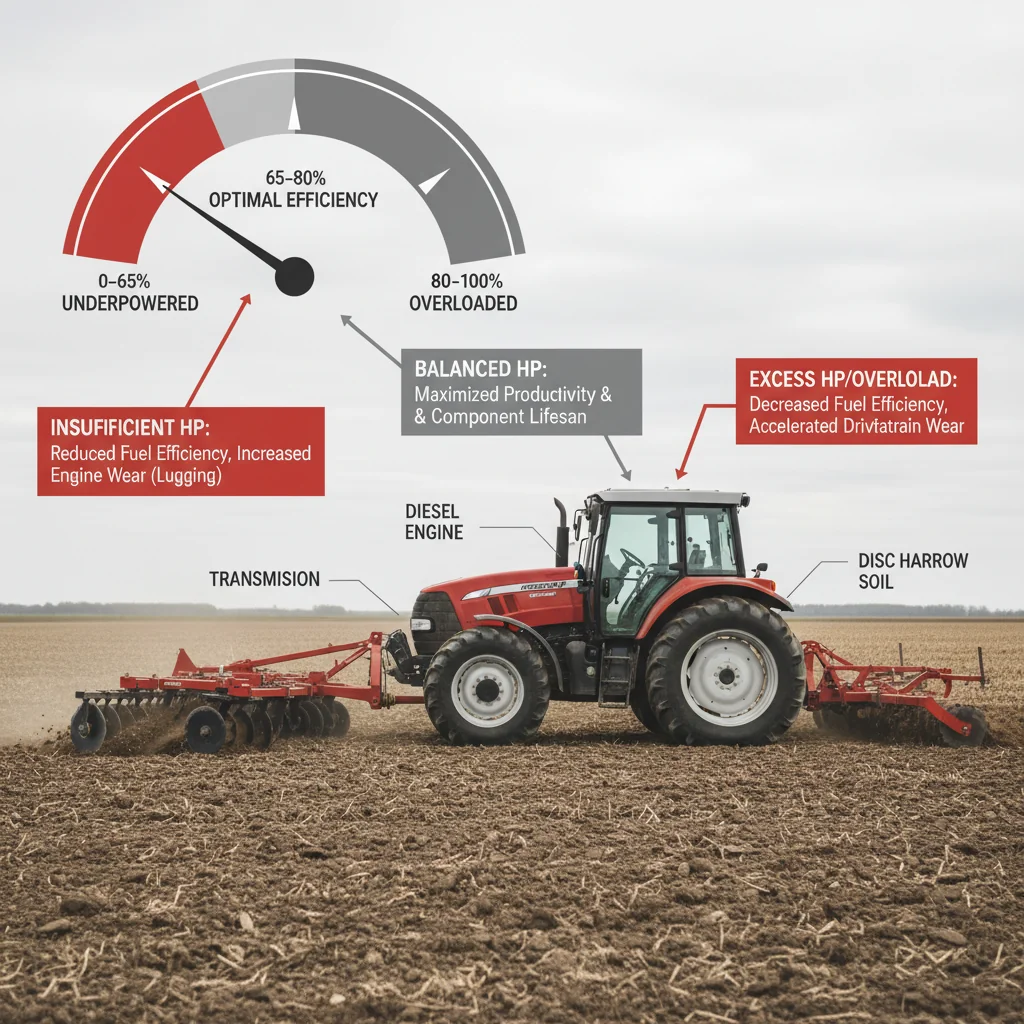
The biggest mistake I see is buyers chasing the highest horsepower they can afford, thinking more is always better. In reality, most field jobs—like plowing, harrowing, or hauling—don’t need the full power of a 120HP tractor. I’ve watched farmers in Brazil run 100HP units at half throttle for most of the season, just because their main implements only require 60–70HP. The rest of that engine’s capacity sits unused, but the fuel and maintenance bills don’t care—they keep climbing. Too much horsepower means burning diesel for power you never touch.
I worked with a wheat farm in Kazakhstan where they started with 85HP tractors for 3-meter disc harrows. The tractors ran at 90–100% load in heavy clay, slowing down and overheating during long shifts. After reviewing their actual field loads, I suggested moving to 110HP units. That let them run at 70–75% load—right in the efficiency sweet spot. Fuel use dropped, and the tractors handled tough soil without strain. The difference in engine hours and repair costs was obvious after just one season.
Here’s what matters most: match your tractor’s rated horsepower to the real demands of your implements, soil, and average working speed. Don’t just look at “maximum” needs—think about your most common jobs. Aim for a setup where your main tasks keep the engine working at 65–80% of its rated power. I suggest listing your implements, checking their true power draw, and choosing a tractor just above that range. That’s how you get reliable performance and avoid wasted investment.
Operating a tractor with significantly more horsepower than the implement requires can lead to inefficient fuel consumption and increased wear on engine components.True
When a tractor is routinely used at loads well below its optimal operating range, the engine may not reach its most efficient fuel burn rate, and components can experience unnecessary wear due to lower operating temperatures and incomplete combustion.
Selecting a tractor with maximum available horsepower will always result in faster completion of fieldwork, regardless of implement size.False
Fieldwork speed is limited by the implement's capacity and the soil conditions, not just engine horsepower. Excess horsepower does not translate to faster work if the implement or soil cannot utilize that extra power.
Key takeaway: Tractor efficiency peaks when engine power is sized so most tasks use 65–80% of rated horsepower. Oversized engines waste fuel and money, while undersized engines cause strain and inefficiency. Accurate implement, soil, and speed assessments help select the right tractor power for lasting performance.
How Do Power and Torque Impact Efficiency?
Engine power (hp/kW) determines work speed, while torque provides the pulling force for implements. The relationship Power = (Torque × RPM) / 5252 links both. Effective field tractors emphasize torque rise3—typically 25–35%—so the machine maintains speed under heavy loads, boosting efficiency beyond peak horsepower ratings alone.
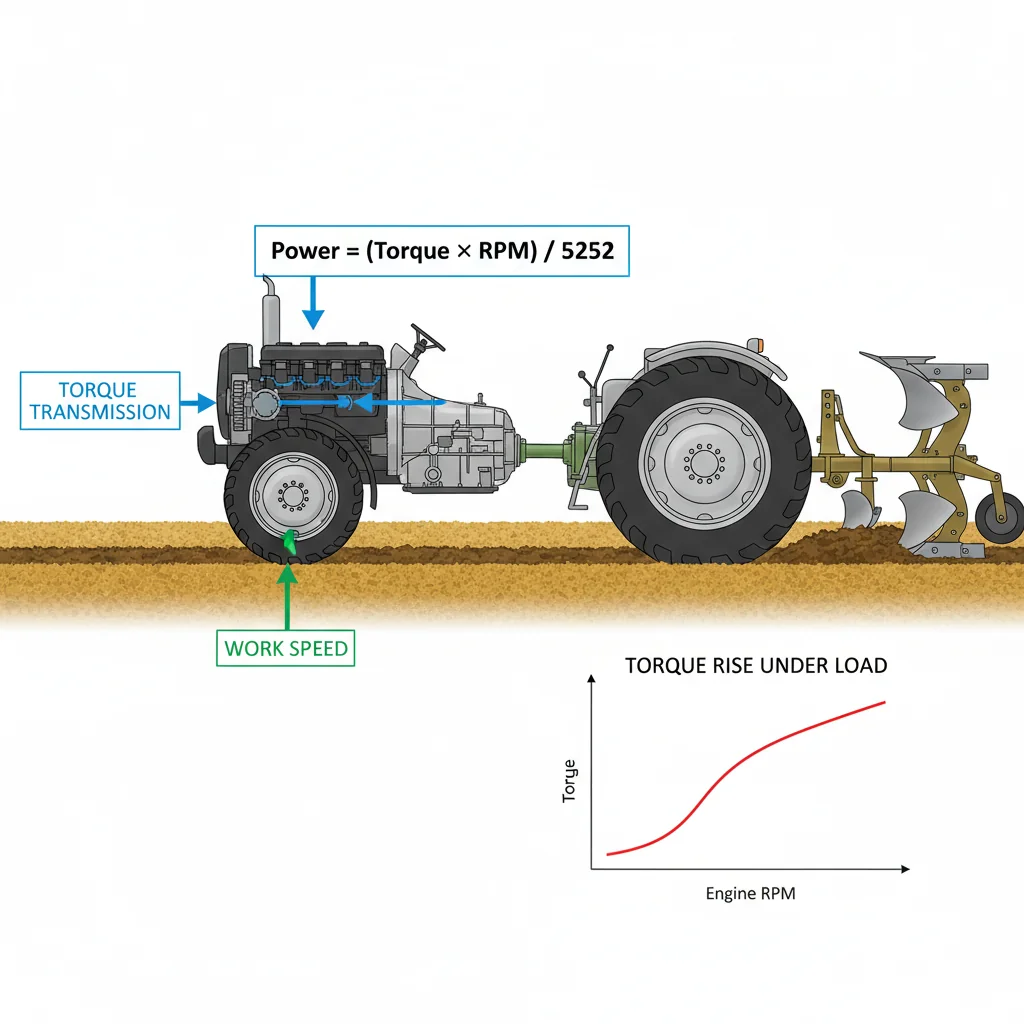
Let me share something important about tractor performance that a lot of buyers miss: horsepower gets attention, but torque is what keeps your implements moving when the soil turns heavy or the slope gets steep. Power tells you how quickly the tractor can do a job, but torque is the force that actually pulls a plow or harrow through tough ground. The formula—Power = (Torque × RPM) / 5252—shows they’re linked, but in real field work, it’s the shape of the torque curve and the amount of torque rise that matter most.
I saw this firsthand on a maize farm outside Lusaka, Zambia. The owner switched from a 90HP tractor with just 20% torque rise to a similar model with about 32% torque rise. On wet days, the first tractor struggled and lost speed whenever the disc harrow sank in. Operators had to drop a gear and run at higher revs, burning more diesel and losing at least two working hours per field. With the higher torque rise machine, they kept the same gear and pace—even under thick stubble—using noticeably less fuel.
That’s the real difference: a tractor with strong torque rise (usually 25–35%) lets you power through tough patches without constant gear shifting or stalling. It’s not just about the peak number printed in the brochure. I always suggest you check the torque curve, not just rated horsepower, before buying. This helps ensure your tractor will stay efficient and reliable in real field conditions—especially if you’re working heavy soils or hilly land.
A tractor with a broad and flat torque curve maintains better efficiency under variable loads compared to one with the same peak power but a narrow torque band.True
A broad, flat torque curve allows the tractor to deliver more usable pulling force across a wide range of engine speeds, minimizing the need for frequent gear changes and reducing fuel waste during fluctuating field conditions.
Higher horsepower always means a tractor will be more efficient in field work, regardless of the torque characteristics.False
Efficiency in field work depends not just on total horsepower but on how much torque is available at the speeds where implements are used. A high horsepower rating without sufficient low-end torque can lead to increased fuel consumption and poor performance when pulling heavy loads.
Key takeaway: Tractors with strong torque rise and a well-shaped torque curve maintain speed and efficiency under load, allowing operators to work longer in the optimal gear. Always assess torque characteristics, not just rated horsepower, to ensure reliable, fuel-efficient performance in field conditions.
Why Does Optimal RPM Improve Tractor Efficiency?
Operating a tractor engine near its optimal rpm—typically 1,700–2,100 rpm at 65–85% load for modern diesels—maximizes fuel efficiency. Field tests confirm that matching implement load to this engine ‘sweet spot’ or using ‘gear up, throttle back4’ strategies under light loads can reduce fuel consumption by 15–30%.
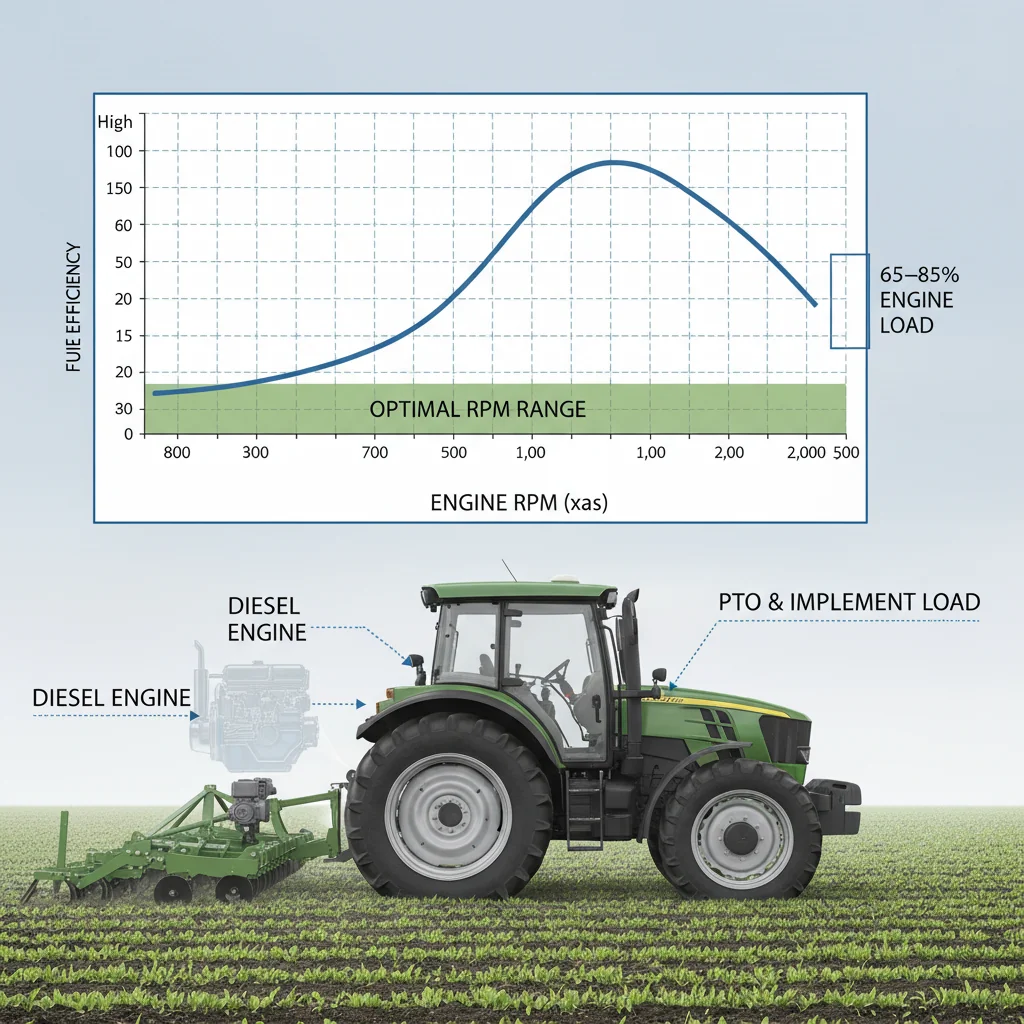
Most people don't realize that the way you run your engine—especially the rpm—can make or break your fuel costs over a season. In many of the farms I visit in Brazil and Kazakhstan, operators simply set the throttle high and leave it there, thinking more rpm equals more power. But diesel engines in conventional tractors are actually most efficient at a certain point—usually between 1,700 and 2,100 rpm, and when they're working with a load that uses about 65–85% of rated power. I’ve seen the difference firsthand. For example, a customer in Bolivia switched from running at max rpm to matching their disc harrow size better and operating at 1,850 rpm. Their fuel use dropped noticeably—at least two tankfuls saved per week during peak tillage.
Here's the thing—if your implement is too light, the engine just burns extra fuel without doing useful work. In that case, I always suggest two options. Either combine operations where possible (like harrowing and fertilizing together), or use a wider tool to bring the load closer to that “sweet spot.” If you’re stuck with a light load, try “gear up, throttle back”—shift to a higher gear, reduce engine speed, but keep your working speed steady. I’ve seen this trick save 15–30% on fuel, especially during shallow tillage or transport.
The reality is, running at high speed with little load just wastes diesel. I suggest watching your engine load5 gauge or, if you don’t have one, pay attention to exhaust smoke and engine sound. Adjust your gear and throttle until the engine feels strong but not strained. That’s where you get true efficiency—and that’s money in your pocket.
Running a tractor engine consistently above its optimal rpm range can actually decrease fuel efficiency, even if the tractor is not delivering more usable power.True
Diesel engines in tractors are designed to deliver maximum efficiency within a specific rpm band, typically when operating at a load that utilizes most of the engine's rated power. Exceeding this rpm range leads to higher fuel consumption without proportional gains in effective power output, due to increased friction and reduced combustion efficiency.
Operating a tractor at the highest possible rpm always ensures the most efficient use of fuel and engine power.False
The most efficient use of fuel occurs when the engine runs within its optimal rpm range under the appropriate load. Running at maximum rpm increases fuel consumption and engine wear without delivering proportional increases in work output, making it less efficient overall.
Key takeaway: Running tractor engines at or just below rated rpm with an appropriately matched load significantly increases fuel efficiency. Using strategies like combining operations or ‘gear up, throttle back’ helps maintain engine performance within the most efficient range, directly reducing fuel costs and overall operational expenses.
How Does Engine Size Affect Fuel Use?
Engine horsepower rating directly impacts fuel consumption per hour—larger engines generally burn more fuel, even at low load. However, fuel use per hectare and total cost per hectare are most important. Oversized tractors waste fuel and money, while undersized units increase wear and operating time.
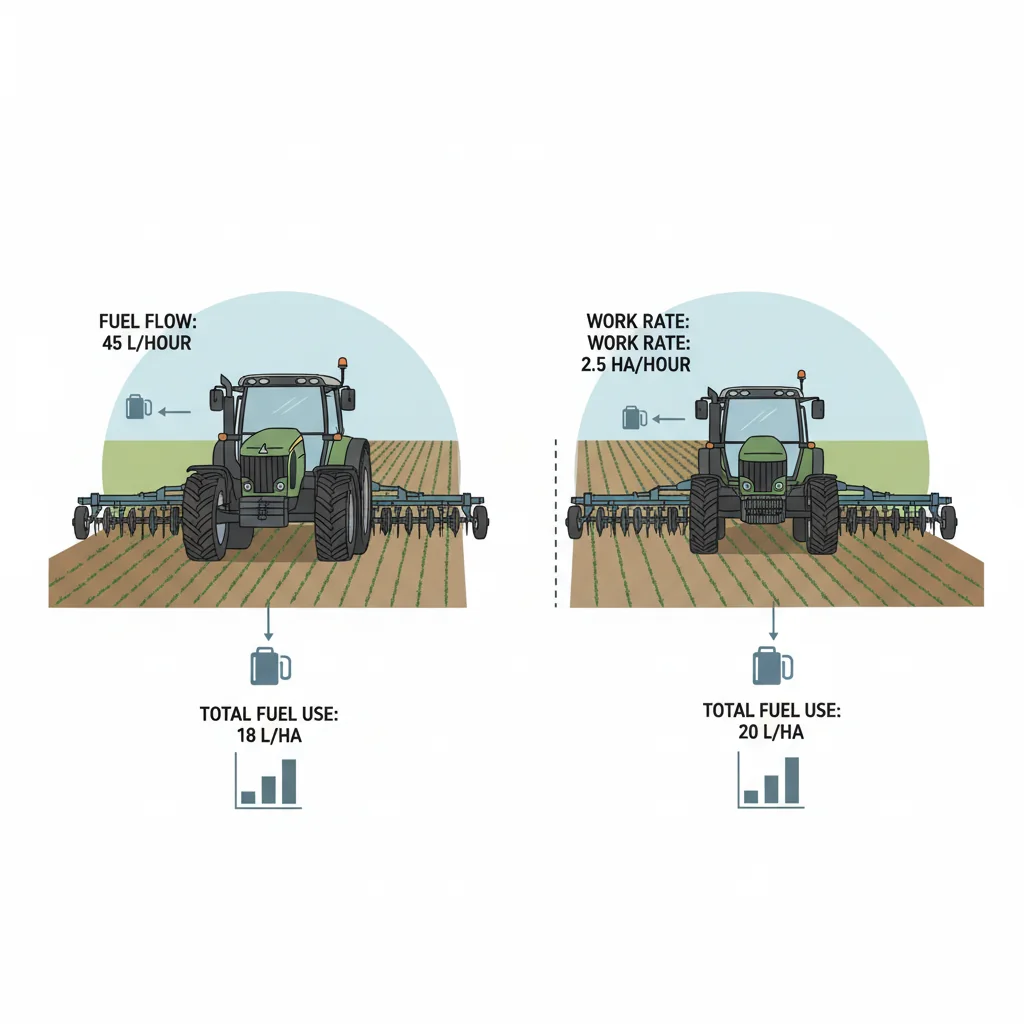
To be honest, the spec that actually matters is fuel consumption per hectare6—not just per hour. I’ve worked with buyers in Brazil who thought a 160HP tractor would give them more flexibility. But when they used it for light tillage, the engine was barely working and still burned 3–4 liters more fuel per hour than a 90HP unit doing the same job. Over a season, that extra fuel adds up quickly—often 2,000 liters or more if you run 600 hours per year. And you’re paying more upfront for power you rarely use.
Here’s what really drives your true operating cost per hectare:
- Engine horsepower: Bigger engines use more fuel per hour, even at low loads. You rarely get that fuel back in faster work except with heavy implements.
- Field matching: A right-sized tractor (say, 75–100HP for 2-4 bottom plows on medium soil) finishes the work efficiently, usually in one pass at a steady pace.
- Workload balance: Undersized tractors, like a 55HP unit pulling a heavy disc harrow, run close to max load. That means slower working speed, higher fuel per hectare, and more wear on the engine, clutch, and axles.
- Total cost: Oversized tractors cost more to buy, maintain, and depreciate. You end up with higher costs per hectare for no real gain.
In Kazakhstan, I saw a farm switch from 120HP units down to 90HP for their regular seeding jobs. Their fuel bills dropped by almost 25%, and their maintenance headaches went down too. I always suggest matching your tractor’s power to your heaviest regular job—nothing more, nothing less. That’s the real sweet spot for both efficiency and savings.
Using an oversized tractor for light-duty tasks often results in higher fuel consumption per hectare, since the larger engine operates inefficiently at low loads.True
Tractor engines are designed to run most efficiently near their optimal load. When a high-horsepower engine is underused, it burns more fuel per hour relative to the work performed, increasing fuel use per hectare compared to a correctly sized tractor.
A tractor with a bigger engine will always be more fuel efficient, regardless of the type of work or implement used.False
Larger engines are not inherently more efficient for all tasks; in fact, they tend to waste fuel on light jobs where their power isn't needed. Efficiency depends on matching engine size to the workload, not just engine capacity.
Key takeaway: Selecting the correct engine power for regular field tasks maximizes tractor efficiency and minimizes both fuel consumption and ownership costs. The optimal choice is the smallest tractor that can reliably manage the heaviest expected workload without being consistently over- or under-loaded.
How to Match Engine Power to Implements?
Efficient tractor operation depends on matching engine power to implement requirements and task types. For example, heavy primary tillage typically requires 20–25 horsepower per meter7, while seeding with heavy air seeders needs 3–5 horsepower per row. Correct pairing prevents underloading, optimizes fuel use, and maintains consistent field performance.
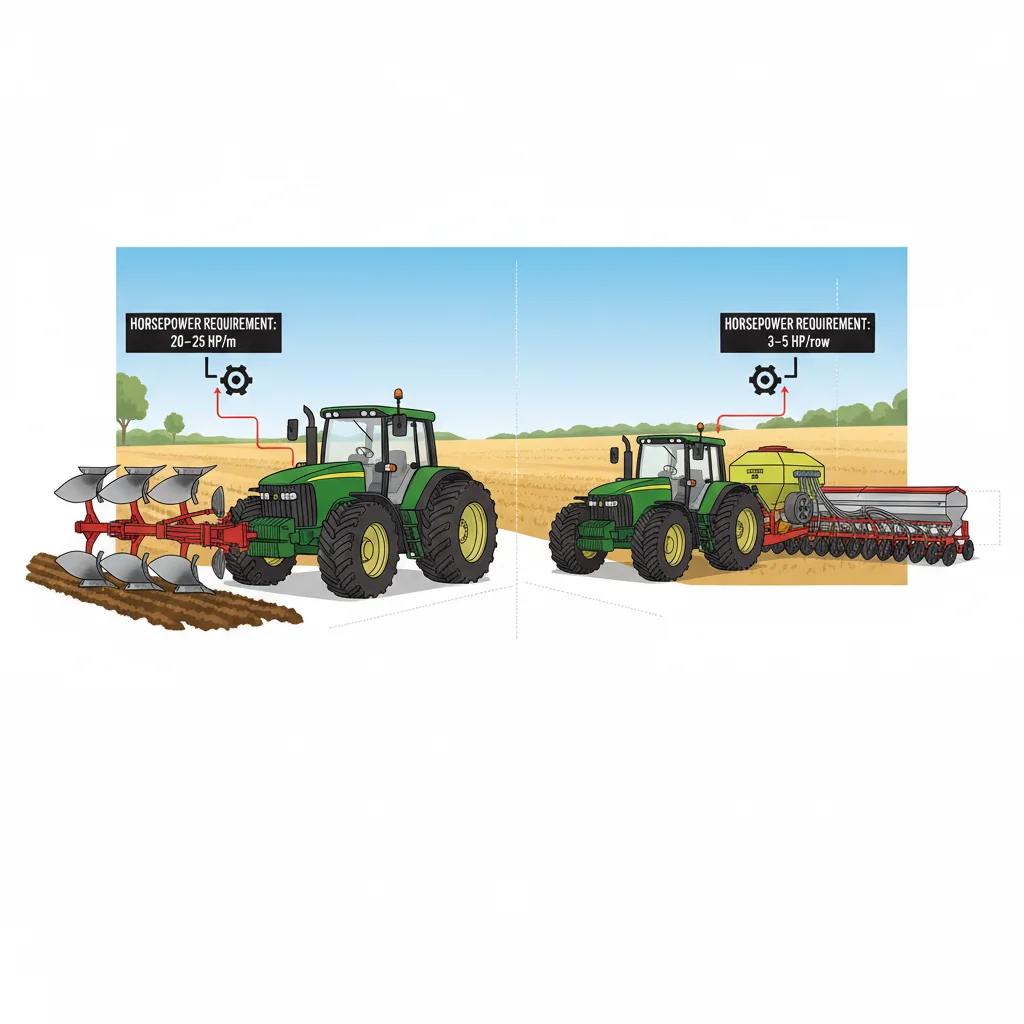
Here’s what matters most when matching engine power to implements: don’t just look at the maximum horsepower on the spec sheet. Think about the specific jobs on your farm and the real pull each implement needs. For example, heavy primary tillage—like deep plowing or breaking up virgin land—usually requires 20–25 horsepower per meter of implement width. So, if you’re running a 3-meter disc plow in average loam soil, you’ll want at least 60 to 75 PTO horsepower8. I’ve seen farms in Kazakhstan pair a 120HP tractor with that same plow, thinking bigger is always better. In reality, they ended up wasting fuel and running the engine underloaded most of the year.
Matching power gets even more important with PTO-driven implements. Take a large baler or a forage harvester—these tools demand steady PTO horsepower and plenty of torque backup, especially as crop conditions change. One customer in Bolivia used a 90HP tractor for a big round baler rated for 80HP. On dry days, it worked fine, but in heavy, wet grass, the engine struggled and baler output dropped. That’s why I always ask customers to map out their main jobs: tillage, seeding, transport, or loader work. The right match means the engine works efficiently, keeping fuel use reasonable and wear under control.
I suggest gathering your annual work data—hours spent on each task, typical soil conditions, and implement sizes. Use those real numbers to choose both the tractor and implements together. That way, you avoid both underloading and overspending on engine size, and your tractor delivers consistent results season after season.
Selecting a tractor with significantly more engine power than needed for the implement can reduce fuel efficiency and cause unnecessary wear on drivetrain components.True
Oversizing the tractor for the implement leads to inefficient fuel use and increased mechanical stress. Tractors operate most efficiently when engine load matches implement demand; excessive power results in underloading, which is less efficient and can cause engine glazing or other long-term issues.
Implement width is the only factor that determines the engine power required for efficient operation in field conditions.False
While implement width is important, other factors like soil type, implement design, working depth, and field conditions also significantly influence the engine power needed. Ignoring these can lead to poor performance or equipment strain.
Key takeaway: Selecting tractor engine power based on implement demand and primary job types ensures efficient fuel use, optimal performance, and reduced wear. Proper pairing avoids both underloading and excessive engine size, maximizing productivity for tillage, seeding, and PTO-driven operations in diverse field conditions.
How Does Engine Power Impact Efficiency?
Engine power affects tractor efficiency through internal engine design, not just transmission. Most fuel energy loss occurs as heat due to thermodynamic inefficiency9, friction, and pumping losses. Modern high-efficiency diesel engines, with optimized combustion and advanced fuel injection, achieve lower specific fuel consumption—directly reducing operating costs across varying field conditions.
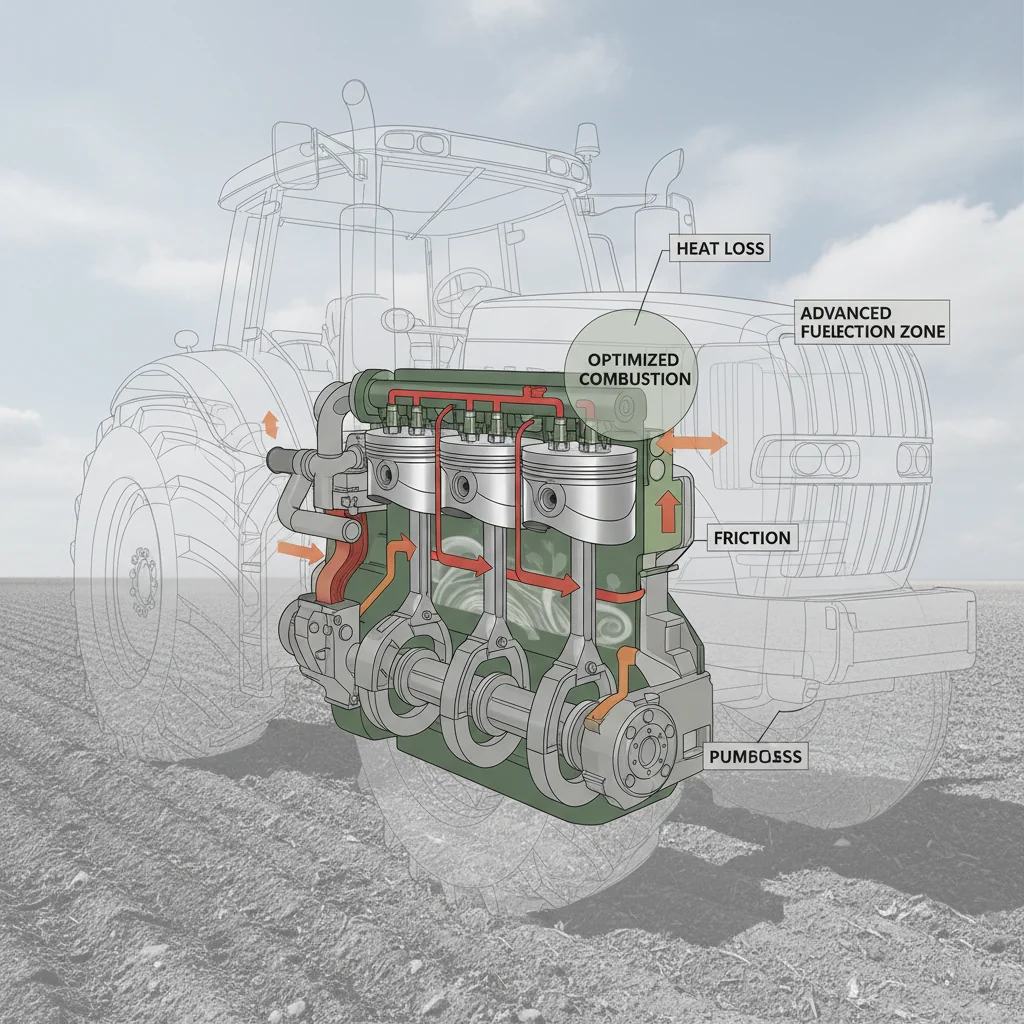
A lot of buyers get stuck on peak horsepower ratings, but the real difference in running costs comes from engine efficiency. Take a farm I worked with in Bolivia—they ran two 90HP tractors side by side, both doing heavy soil prep. One had a basic old-style diesel, the other a newer engine with higher compression and better injection. After a week, the fuel bills told the story: the efficient model used almost 15% less diesel per hectare, even though both had the same rated power. That gap matters when you’re covering hundreds of hectares each season.
The truth is, most fuel energy never reaches the wheels. Inside the engine, you lose a big chunk as heat—thanks to thermodynamic inefficiency, friction, and even the effort of sucking air in and pushing exhaust out. Modern engines fight these losses by using higher compression ratios, precise fuel injection, and better turbocharging. I’ve seen models with specific fuel consumption around 220 grams per kilowatt-hour at their best point. But what really counts is how wide that “efficient” zone is on the fuel map. If the engine only runs efficiently at a single rpm, you’ll waste fuel whenever your field conditions force you to slow down or speed up.
I always suggest looking past the spec sheet. Try to get independent fuel map data if possible, not just peak numbers. Check for engines with strong torque rise—meaning they hold power when things get tough, without burning extra diesel. That’s how you keep fuel costs down and productivity up, no matter if you’re plowing in Peru or planting in Kazakhstan.
Two tractors with identical horsepower can have very different fuel efficiencies depending on their engine technology and design.True
Engine efficiency is influenced by factors like compression ratio, fuel injection precision, and combustion chamber design. Even at the same rated horsepower, a tractor with a more advanced engine can convert more fuel energy into useful work, resulting in lower fuel consumption for the same task.
A tractor’s maximum horsepower rating is the main factor that determines its overall fuel efficiency in the field.False
Maximum horsepower indicates the peak power the engine can produce, but it does not account for how efficiently the engine uses fuel under typical working conditions. Engine design, operating RPM, and load matching all play larger roles in determining actual fuel efficiency.
Key takeaway: Selecting a tractor with an efficient engine—characterized by low specific fuel consumption over a wide rpm range—significantly lowers fuel costs and maintains strong performance under varied field workloads. Always review independent fuel map data to compare real-world efficiency beyond just peak horsepower ratings.
How Much Engine Power Reaches PTO?
Not all rated engine horsepower is available at the wheels or PTO. Drivetrain efficiency10 typically ranges from 56% to 86%, averaging 72.5%. Factors such as transmission design, type of work, and operating conditions impact power delivery. Mechanical and hydraulic losses mean actual usable power is often significantly less than engine rating.
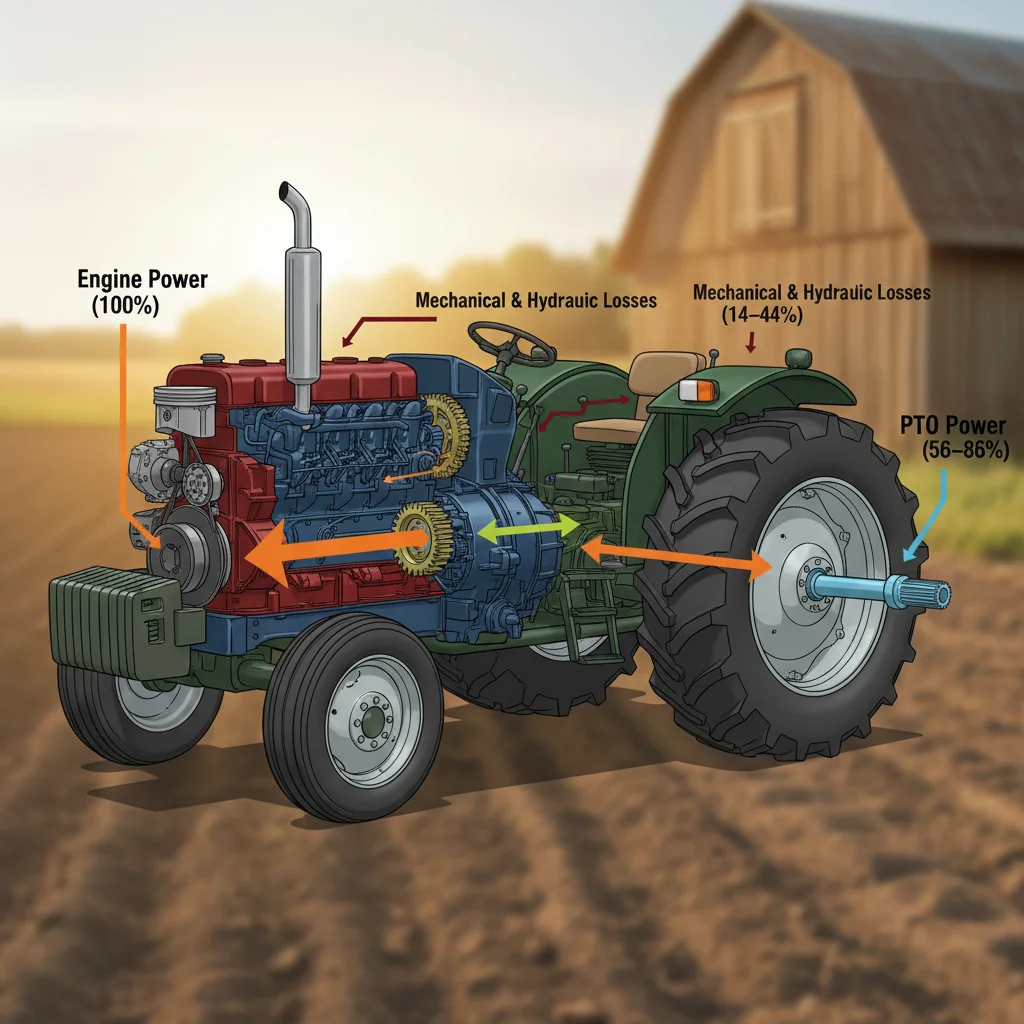
Last month, an importer in Bolivia asked me why his new 100HP tractors weren’t pulling as well as expected. On paper, the engine had plenty of power. But after checking the PTO specs, I saw the real issue—only about 72HP made it to the PTO shaft. The rest disappeared through transmission and hydraulic losses. That’s not unusual. From my experience, drivetrain efficiency varies a lot depending on model, age, and how well the transmission is matched to the job. In tough fieldwork, especially with older or less-maintained gearboxes, I’ve seen efficiency drop to 60% or even lower.
A real-world example: in central Kazakhstan, a customer compared two 90HP tractors. One had a simple mechanical transmission, the other used a high-flow hydraulic system. On identical deep plowing work, the mechanical unit consistently delivered more power at the drawbar, even though both had the same engine rating. The difference? The mechanical drivetrain wasted less energy as heat and fluid friction. That meant better fuel efficiency and more hectares covered per day. It’s a classic case of “spec sheet gap”—the numbers look similar, but field performance tells another story.
So, don’t just look at engine horsepower when you’re choosing a tractor for heavy jobs like plowing or running a large PTO-driven pump. I always suggest checking the manufacturer’s rated PTO and drawbar horsepower figures. If you work in dusty or hot conditions, or do a lot of draft work, even small drivetrain losses can add up quickly. The most reliable results come from matching efficient drivetrains with the right ballast for your soil and implements.
Drivetrain losses in tractors can be higher during heavy draft fieldwork compared to light transport tasks, causing even less engine power to reach the PTO.True
Under high load conditions, such as plowing, the drivetrain works harder and frictional losses increase, so the efficiency drops and less power is available at the PTO compared to lighter operations like road transport.
All tractors with the same engine horsepower will deliver the same PTO power, regardless of their transmission type or age.False
Transmission design, maintenance, and wear all impact how much of the engine's power actually reaches the PTO. Different models and older tractors may have greater losses, so PTO power can vary widely even for tractors with identical engine ratings.
Key takeaway: Drivetrain efficiency, not just engine horsepower, determines how much power actually reaches the drawbar or PTO. When selecting a tractor, compare both engine and drawbar/PTO horsepower, and consider drivetrain losses. Efficient power transfer can make a lower-horsepower tractor outperform a higher-rated but less efficient machine.
How Do Transmissions Impact Tractor Efficiency?
Transmission type directly affects how engine power translates to field efficiency. Traditional gear transmissions11 offer mechanical simplicity and steady efficiency at set speeds but lack flexibility. Continuously Variable Transmissions (CVTs) maintain optimal engine rpm for fuel efficiency under varying loads, though hydraulic losses can offset gains unless engine and implement demands are well matched.
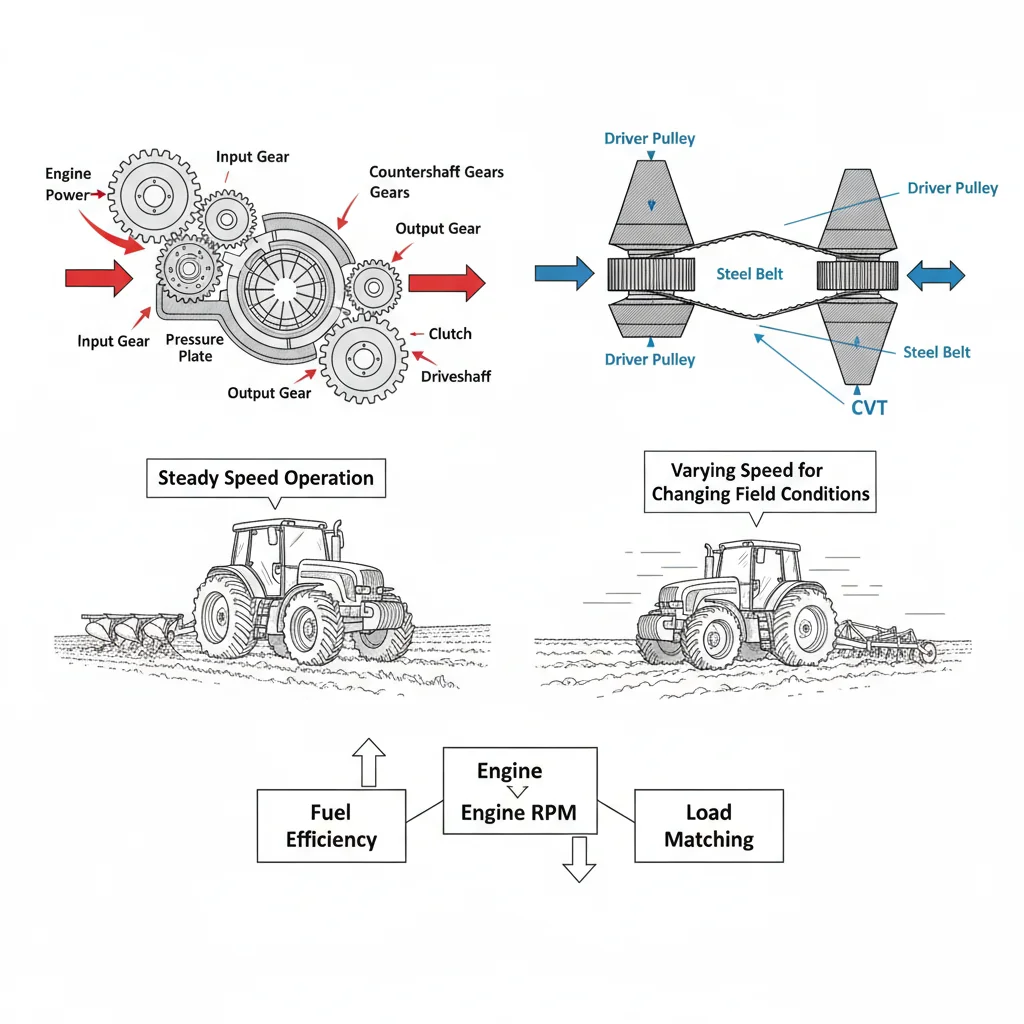
From what I’ve seen in Brazil and Kenya, the type of transmission makes a real difference once you get to the field. Traditional gear transmissions—what most people call “sliders” or “synchros”—are simple and tough. They transfer engine power directly to the wheels with almost no loss, especially when you pick the right gear for the job. I’ve worked with farms running 90HP 4WD tractors for plowing heavy clay. They stick to one gear, keep the engine at 1,800 rpm, and get hours of steady work without burning excess fuel. That’s where gear transmissions shine—steady speed, heavy draft.
But not every job is that straightforward. In Kazakhstan, I helped a customer who needed to mow uneven ground and bale hay where speed and load kept changing. He tried using a standard gear transmission first. The problem? Every time the terrain shifted, he had to stop and change gears. That lost him time and made the engine rev higher or lower than ideal, wasting fuel. This is exactly the kind of situation where a Continuously Variable Transmission (CVT) can pay off. CVTs let you keep the engine at its most efficient rpm while adjusting ground speed smoothly. For mixed tasks—loader work, mowing, baling—operators report less fatigue and better fuel economy, especially on 120HP models.
Still, I always remind buyers: CVTs are more complex. Hydraulic losses can eat into fuel savings if you’re mostly pulling at constant speed. For steady, heavy work, a well-matched gear transmission is often just as efficient and far simpler to maintain. It’s about matching your tractor’s transmission to the real jobs on your land.
A tractor with a properly matched engine and gear transmission can maintain consistent power delivery in heavy soils, reducing fuel waste compared to frequent gear shifting.True
When engine speed and gear selection are optimized for soil and load conditions, the powertrain operates in its most efficient range. This minimizes power loss, prevents unnecessary fuel consumption, and allows the tractor to perform sustained work without overloading the engine.
Engine horsepower alone determines tractor efficiency in the field, regardless of the type of transmission used.False
Tractor efficiency is influenced by both engine power and transmission type. An efficient transmission ensures that engine power is effectively transferred to the wheels and implements. A mismatch between engine and transmission can result in power loss, excessive fuel use, and reduced productivity, even if the engine has high horsepower.
Key takeaway: Selecting the right transmission—gear or CVT—impacts how efficiently a tractor uses engine power. CVTs excel in variable-speed tasks, while gear transmissions suit steady heavy loads. Proper matching to field conditions and implement demand is essential for maximizing efficiency and reducing fuel consumption.
How Do Power, Weight, and Traction Interact?
Engine power alone does not guarantee tractor efficiency. Effective draft performance requires balancing horsepower with appropriate chassis weight and traction. Insufficient weight leads to wheel slip, soil damage, and fuel waste, while excess ballast increases rolling resistance. Optimal setup matches power, mass, ballast, tires, and brakes to implement size and terrain.
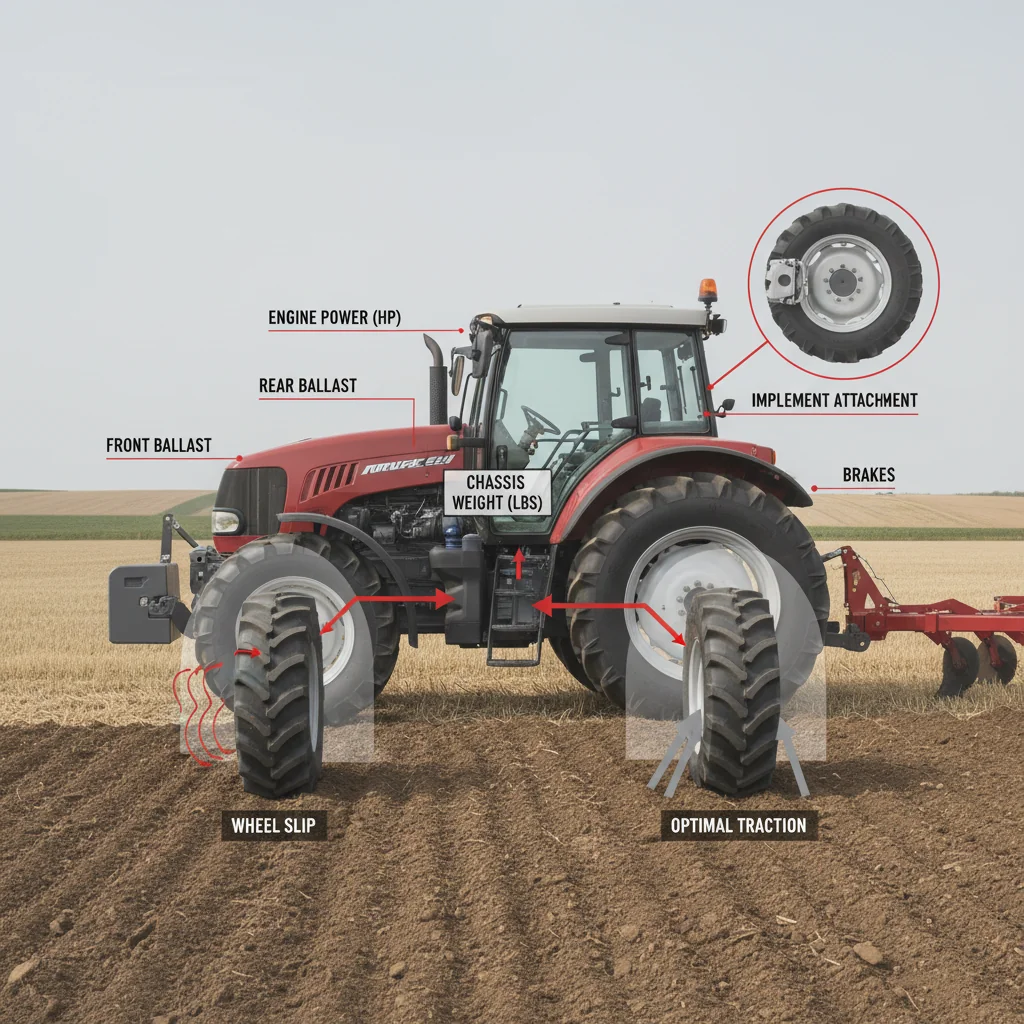
Let me share something important about matching tractor power with weight and traction. I’ve seen too many buyers in Peru and Kenya order 120HP tractors expecting top performance, only to complain later about wheel slip and high fuel bills. The problem? They ran those machines on light chassis, often under 5.5 tonnes, with minimal ballast. On soft or uneven soil, the rear tires spun instead of gripping, so much of that advertised horsepower never reached the ground.
In one case in Kazakhstan, a client tried to pull a heavy four-disc plow with a 100HP tractor weighing just over 4 tonnes. The result was constant spinning and deep ruts. They finished the job, but it took almost twice as long and burned through extra fuel. After we added 800 kg of rear ballast and switched to wider tires, wheel slip dropped below 12%. Suddenly, the same job finished 30% faster and with less diesel per hectare. That’s the kind of field result that never shows up on a brochure.
Too much ballast can hurt, too. I’ve seen operators overload tractors with unnecessary weights, thinking it’s safer. But this only increases rolling resistance, wears out tires, and wastes fuel—especially during lighter jobs like spraying or transport. The sweet spot for heavy draft work is usually about 45–55 kg per horsepower, but you need to adjust for your implements and soil. I always suggest checking tire size, three-point hitch rating, and especially brakes if you’re working on slopes or hauling big trailers. Right balance means safer, more efficient work—no wasted power, no extra costs.
A tractor with high engine power but insufficient weight or ballast often experiences excessive wheel slip, which prevents efficient transfer of power to the ground and reduces overall field productivity.True
Efficient power transfer requires sufficient weight and proper ballast to maximize tire grip. Without enough weight, powerful tractors lose traction, causing wheels to spin and energy to be wasted rather than being used for pulling implements.
Increasing a tractor's engine power always improves its efficiency in the field, regardless of chassis weight or soil conditions.False
Engine power alone does not guarantee efficiency. Without matching weight and proper traction, additional horsepower can lead to slippage and fuel waste, especially on light chassis or challenging soils. Efficiency depends on the balance of power, weight, and traction, not just engine output.
Key takeaway: Tractor efficiency depends on the right combination of engine power, weight, and traction. Overpowered, underweighted tractors waste fuel and risk safety, while excessive ballast is inefficient. Always match the tractor’s weight, tires, and ballast to horsepower and field conditions for best results.
What Risks Come With High-Output Engines?
High-output, turbocharged tractor engines deliver strong performance and improved combustion efficiency at higher cylinder and injection pressures. However, they are vulnerable to damage from improper loading, infrequent maintenance, dirty air filters, or poor-quality fuel. Consistent underloading increases risk of soot buildup, wet stacking12, and reduced turbocharger or DPF lifespan, raising long-term operating costs.
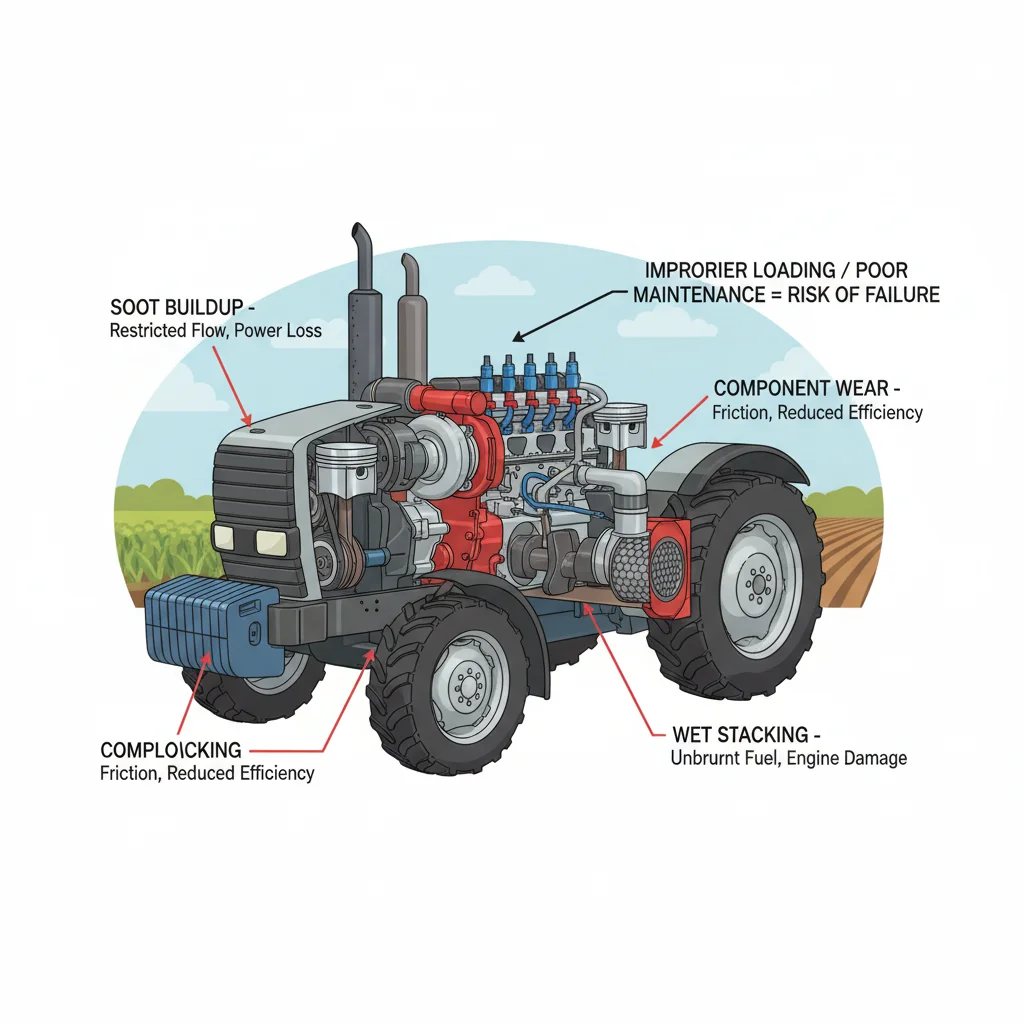
Here's what matters most when dealing with high-output tractor engines: these machines might promise strong performance, but they come with extra responsibility. Higher cylinder pressure and turbocharging mean more stress on pistons, rings, and turbochargers. If you’re running a 120HP or 150HP tractor on light transport or shallow cultivation most of the year, the engine rarely reaches its efficient range. I’ve seen this in Kazakhstan, where a large farm used oversized 140HP units for mostly light trailer work. After two seasons, several engines showed wet stacking—unburned fuel collecting in the exhaust—and the DPFs (diesel particulate filters13) needed early replacement, which cost them nearly $2,000 per unit.
A common mistake is thinking “bigger is safer,” especially for future expansion. But high-output engines are less forgiving if you run them under low load or skip regular servicing. Dirty air filters, poor-quality diesel, or long oil-change intervals all hit harder on these engines. I remember a distributor in Peru had to replace three turbochargers in one year because customers used local fuel with high sulfur and skipped scheduled filter changes. On smaller engines, you might get away with some neglect—on these, it’s expensive fast.
If you choose a higher-horsepower tractor, plan for real work. I always suggest matching your tractor to the heaviest regular job—like deep plowing or heavy transport—and keep the engine loaded at least 70% of the time during peak use. Otherwise, a well-chosen 80HP or 100HP model, kept in its efficient range, will often last longer and cost less over five to ten years.
High-output tractor engines are more prone to incomplete combustion and carbon buildup when operated for extended periods at low loads.True
When high-output engines run at low power demands for most of their operating hours, they often fail to reach optimal combustion temperatures. This can lead to incomplete fuel burn and increased carbon deposits in the cylinders and exhaust system, which negatively impacts engine efficiency and longevity.
Using a tractor with a significantly oversized engine for light-duty tasks always results in higher fuel efficiency due to lower engine strain.False
Operating an oversized engine at low loads can actually decrease fuel efficiency, as these engines are designed to run most efficiently near their peak operating range. When used lightly, they may operate outside their optimal efficiency band, leading to wasted fuel and increased wear.
Key takeaway: High-output engines boost tractor efficiency but require strict adherence to maintenance and proper load management. Consistently running these engines under low load or neglecting servicing can lead to reliability issues and increased costs, making appropriate sizing and usage critical for long-term value.
Conclusion
We've looked at how matching engine power to your typical workload keeps your tractor running efficiently and avoids wasted fuel or unnecessary wear. From what I’ve seen, choosing a tractor just for the biggest horsepower number can lead to the “spec sheet gap”—where what looks good on paper doesn’t match what works in the field. Before you decide, I suggest checking your main implements’ requirements and making sure parts can be sourced quickly in your region. If you have questions about sizing, attachments, or want to hear what’s worked for other importers and farmers, feel free to reach out. Every farm is different—choose what actually works for your needs.
References
-
Explore how specific fuel consumption measures engine efficiency and impacts fuel costs in agricultural tractors with expert data insights. ↩
-
Explore how engine horsepower influences fuel use and operating costs, helping farmers choose the right tractor size for efficiency. ↩
-
Explore how torque rise improves tractor performance under heavy loads, boosting efficiency and reducing fuel consumption in tough field conditions. ↩
-
Details the technique of shifting to higher gear and reducing engine speed to lower fuel consumption without sacrificing work output. ↩
-
Details the benefits of running tractors at 65–80% load for fuel savings, reduced wear, and better performance in agricultural tasks. ↩
-
Understand why measuring fuel use per hectare gives a clearer picture of costs and efficiency in agricultural operations. ↩
-
Detailed guidance on calculating horsepower per meter helps optimize tractor-implement matching and improve fuel efficiency in fieldwork. ↩
-
Explains the role of PTO horsepower in powering implements like balers and harvesters, ensuring consistent performance under varying crop conditions. ↩
-
Understand the causes of thermodynamic inefficiency in diesel engines and its role in fuel energy loss and reduced tractor efficiency. ↩
-
Explore how drivetrain efficiency affects tractor power delivery and performance, with expert insights on factors causing variation. ↩
-
Learn why gear transmissions offer mechanical simplicity and steady efficiency, especially for heavy draft tasks on farms. ↩
-
Detailed insights on wet stacking causes, effects on engine performance, and prevention methods for turbocharged tractor engines. ↩
-
Explains the role of diesel particulate filters in emission control and maintenance challenges in high-output agricultural engines. ↩