Skip to content
How Engine Power Affects Tractor Efficiency: Practical Field Guide
A few months ago, I watched a cotton farmer in Uzbekistan struggling to finish land prep before the rains. He had a 90 hp tractor working flat-out on a heavy disc harrow, burning fuel fast but crawling across the field. The neighbor, with a slightly bigger machine and wider tool, finished two days ahead—using less diesel per hectare. The difference? Not just horsepower, but how it was put to work.
Engine power rating on a tractor sets the upper boundary for performance, but optimal efficiency depends on matching workloads to the engine’s most economical operating band—typically 60–80% of rated output at moderate RPM. Working consistently in this zone minimizes fuel consumption1 per unit of work and extends component life.
How Does Engine Power Affect Efficiency?
Engine power provides a tractor’s maximum potential, but efficiency peaks when operating at 60–80% of rated power2, usually at 1,700–2,100 rpm for modern diesel engines. Field data shows most tractors run below this range, reducing efficiency. Properly sizing tractors keeps engines in the optimal load band3.
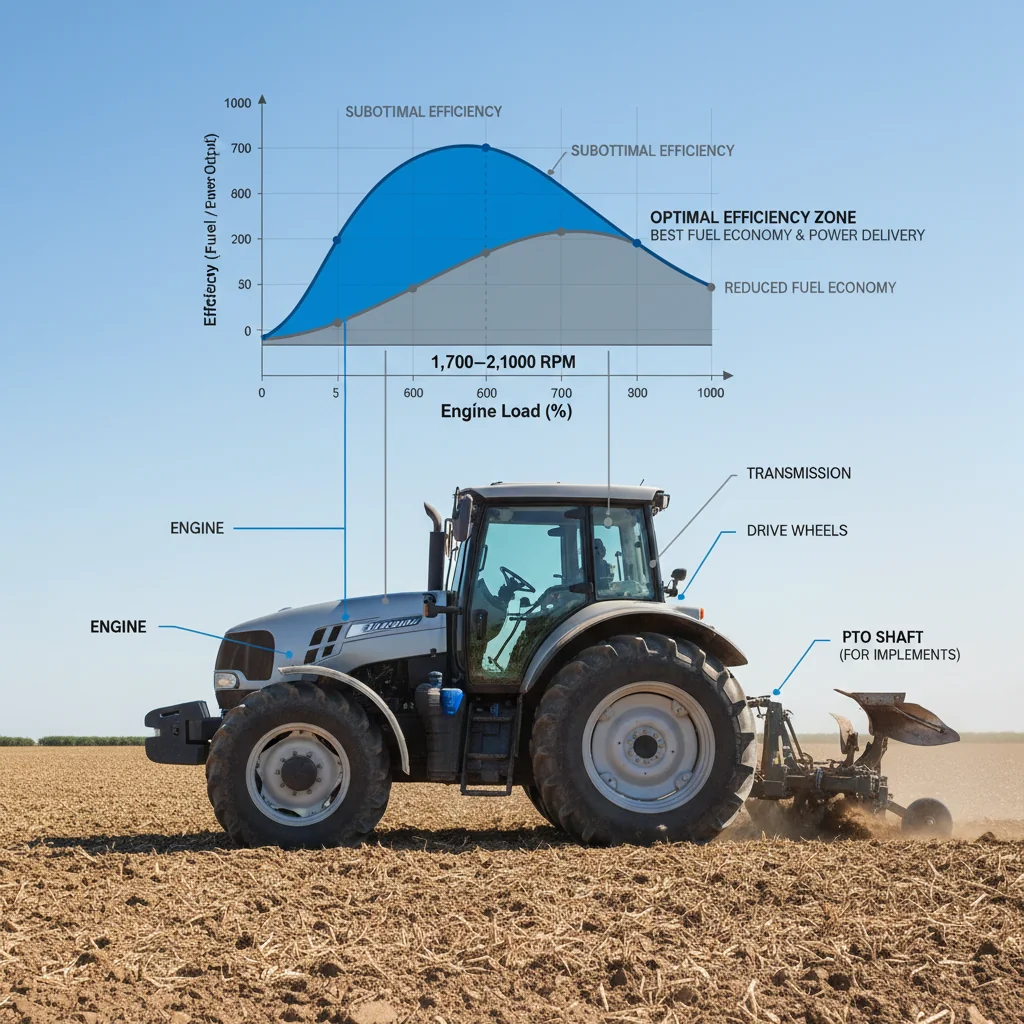
Most people don't realize that engine power is not just about the biggest number on the brochure. What really matters is how close your tractor works to its “sweet spot”—that range where the engine runs most efficiently. For modern diesel tractors, that's usually between 60 and 80% of rated power, at roughly 1,700 to 2,100 rpm. When you stay in this band, fuel burned per hectare drops, and your engine lasts longer because it's not constantly pushed to the limit.
Last season, I worked with a farm in Peru running 90HP units for maize and sugarcane. The problem? They used implements that rarely pulled more than 50HP. On paper, fuel use seemed low, but the engines ran below their optimal load most of the time. The result? Higher fuel use per hectare than expected, and frequent carbon buildup in the exhaust. I see this mistake often—tractors oversized for the job, working at low throttle, never reaching their most efficient operating zone.
On the other hand, I’ve seen a 120HP tractor in Kazakhstan working a 5-bottom plow at around 75HP load, right in the efficiency band. It finished fields faster, used less diesel per hectare, and needed fewer repairs over five years. The key is matching your tractor’s power to your heaviest regular job—not just average tasks. I always tell buyers: size your tractor so those tough jobs put your engine in that 60–80% zone. That’s how you get the best performance and save money over the long run.
Operating a tractor engine consistently within 60-80% of its rated power can improve fuel efficiency and reduce engine wear compared to running at either extreme of its power range.True
Engines are designed to run most efficiently within a specific power band, where fuel combustion and mechanical stresses are optimized. Staying in this range minimizes wasted energy and excessive component stress, leading to better fuel economy and longer engine life.
A tractor with a more powerful engine will always be more fuel efficient, regardless of the task or load.False
Greater engine power does not automatically result in higher fuel efficiency. If a powerful engine is consistently underloaded or run outside its optimal efficiency range, it can actually consume more fuel per unit of work than a smaller, well-matched engine operating closer to its sweet spot.
Key takeaway: Tractor efficiency is highest when the engine operates at 60–80% of its rated power. Selecting a tractor with enough power for common heavy tasks ensures consistent operation in this optimal band, minimizing fuel use per hectare and extending engine lifespan.
When Does More Horsepower Save Fuel?
More engine horsepower can reduce fuel consumption per hectare4 when it is fully utilized—such as by operating wider implements or maintaining optimal working speeds at proper depths. If additional horsepower only increases fuel per hour without raising field capacity5, overall efficiency and liters per hectare may not improve.
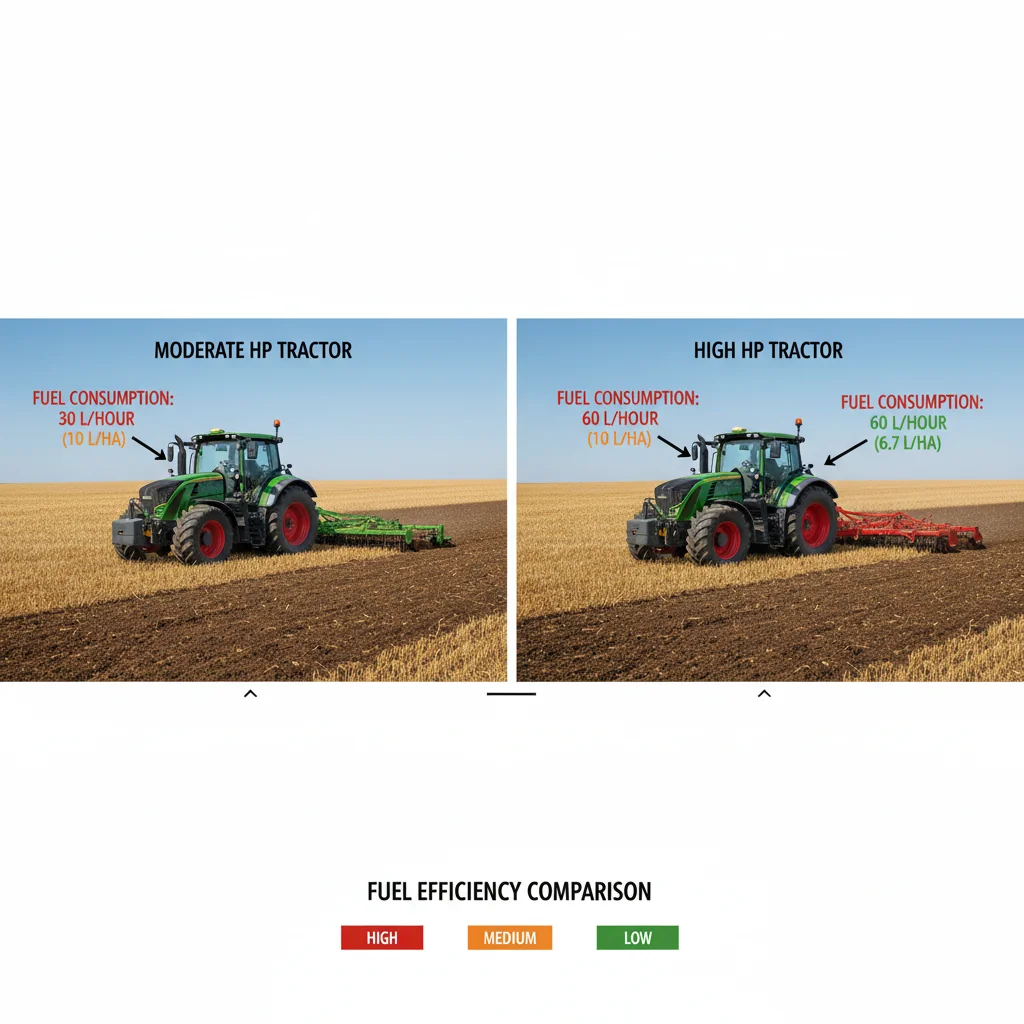
Let me share something important about tractor horsepower that many buyers miss. Just picking a bigger engine doesn’t guarantee you’ll save fuel in the field. The real savings come when you match that extra power to wider implements or faster working speeds—otherwise, you’re just burning more fuel per hour without covering more land.
I’ve seen this firsthand in Brazil. One customer upgraded from a 90HP tractor to a 120HP model. On paper, the bigger machine used about 3 more liters of diesel per hour. But when they paired it with a 2.4-meter disc plow instead of a 1.8-meter one, their field capacity jumped from about 1 hectare per hour to 1.7. Their fuel use per hectare dropped from around 8 liters to about 6.5. That’s real efficiency—not just higher fuel consumption for the sake of it.
Here’s what matters most when making this decision: Are you ready to upgrade your implements too? If you keep using the same size plow or harrow, the higher horsepower only increases your running costs. On the other hand, a 100HP tractor pulling a narrower chisel at higher speed can sometimes match the work rate of a wider, slower setup while reducing soil compaction and driveline wear. It’s not just the engine spec—it’s how you put that power to work.
I always suggest reviewing your typical implements and field conditions before buying more power. That’s the best way to get real savings and make the most of your investment.
Using a tractor with more horsepower only saves fuel when that extra power is used to operate larger implements or work at higher speeds, effectively increasing the area covered per hour.True
A higher horsepower tractor consumes more fuel per hour, but if it is used efficiently by pulling wider implements or working faster, the fuel usage per hectare can decrease because you complete the work in less time.
A higher horsepower tractor will always be more fuel efficient than a lower horsepower tractor, regardless of the implement or working speed.False
If a high horsepower tractor is used with the same implement and at the same speed as a lower horsepower tractor, it will typically burn more fuel per hour without increasing productivity, leading to lower overall fuel efficiency.
Key takeaway: Higher horsepower tractors can lower fuel use per hectare if matched with wider or faster implements and operated correctly. Simply increasing power without adjusting implements or working speed may waste fuel without improving efficiency. Match tractor power to field tasks for optimal results.
How Does Oversized Engine Power Increase Costs?
Oversizing tractor engine power6—buying 30–50 hp extra “just in case”—significantly increases both upfront investment and ongoing fuel costs. Tractors consistently running below 40% load operate 10–20% less efficiently, consuming 1.5 L/hour more fuel. Additional horsepower also raises purchase price, tire, oil, and filter expenses, with little operational benefit for typical loader or mowing tasks.
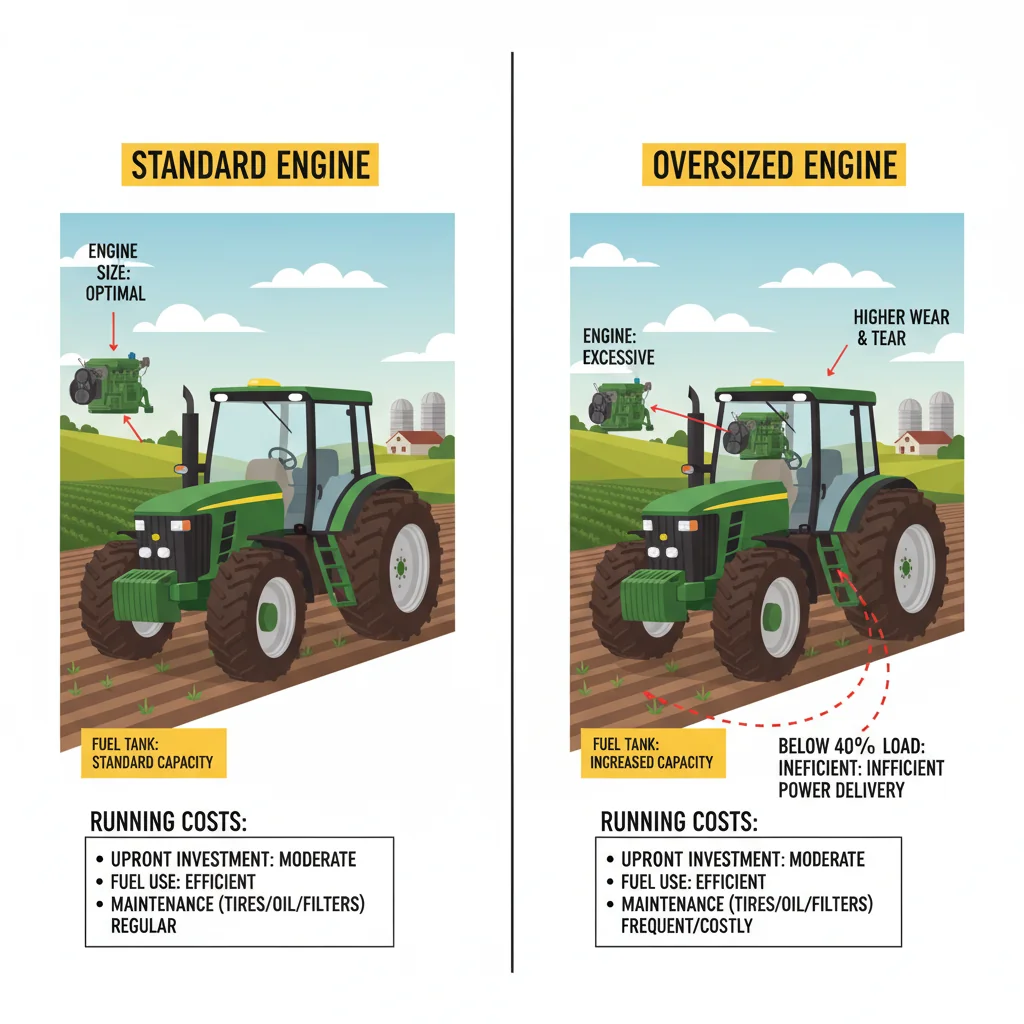
The biggest mistake I see is farmers buying much more engine power “just in case.” In Brazil, I met a grower with a 130HP tractor running a standard 2.5-meter mower—work that rarely needs more than 70HP. He thought extra horsepower meant future-proofing, but his machine ran below 40% load most of the year. The result? Fuel consumption was consistently 1.5 liters per hour higher than a properly sized model. Over 2,000 working hours, that’s around $3,000 extra spent on fuel alone.
Here’s what matters most when you look at total cost: bigger engines don’t just cost more upfront. For every extra 10HP, you usually pay 5–8% more on the purchase price. But it doesn’t stop there. Larger engines mean bigger tires, more expensive oil changes, and pricier filters—especially for mid-size farms in places like Kenya or Peru, where every maintenance dollar counts. I’ve seen owners surprised by these hidden costs after the first season. This is what I call the “second-year surprise”—those recurring expenses that eat into your profit.
If your regular jobs are loader work, mowing, or light transport, you’ll rarely use the full capability of a 100–130HP tractor. The engine won’t reach its efficient load zone, so you pay more for no real benefit. For most mid-size farms, I suggest matching tractor power to your heaviest usual task, not rare extreme jobs. If you occasionally need extra muscle—say, for deep plowing—outsourcing is often far cheaper than oversizing your main tractor.
Operating a tractor at much lower engine load than its optimal range can cause incomplete fuel combustion, leading to increased emissions and higher maintenance needs.True
Tractors are designed to operate efficiently within a specific load range. Running them well below this range can result in incomplete fuel burn, which not only wastes fuel but also produces more soot and carbon buildup, increasing the frequency of maintenance intervals.
Selecting a tractor with oversized engine power always results in lower overall operating costs due to the engine running at reduced stress.False
While it may seem logical that a less-stressed engine will last longer and cost less to operate, oversized engines typically run inefficiently at partial loads, wasting fuel and sometimes causing premature wear from cold running or incomplete combustion. This often increases, rather than decreases, total operating costs.
Key takeaway: Selecting a tractor with excessive engine power for routine tasks leads to higher purchase, maintenance, and annual fuel costs, while rarely improving field efficiency. For mid-size farms, matching tractor horsepower to regular jobs, and outsourcing peak loads, maximizes efficiency and cost-effectiveness.
How does engine power affect efficiency (Continued)?
When a tractor is underpowered for heavy draft work, it must operate at near-maximum load, requiring lower gears and slower speeds. This results in higher fuel use per hectare, greater engine stress, increased exhaust temperatures, and accelerated wear on driveline components, significantly reducing both operational efficiency and engine lifespan.
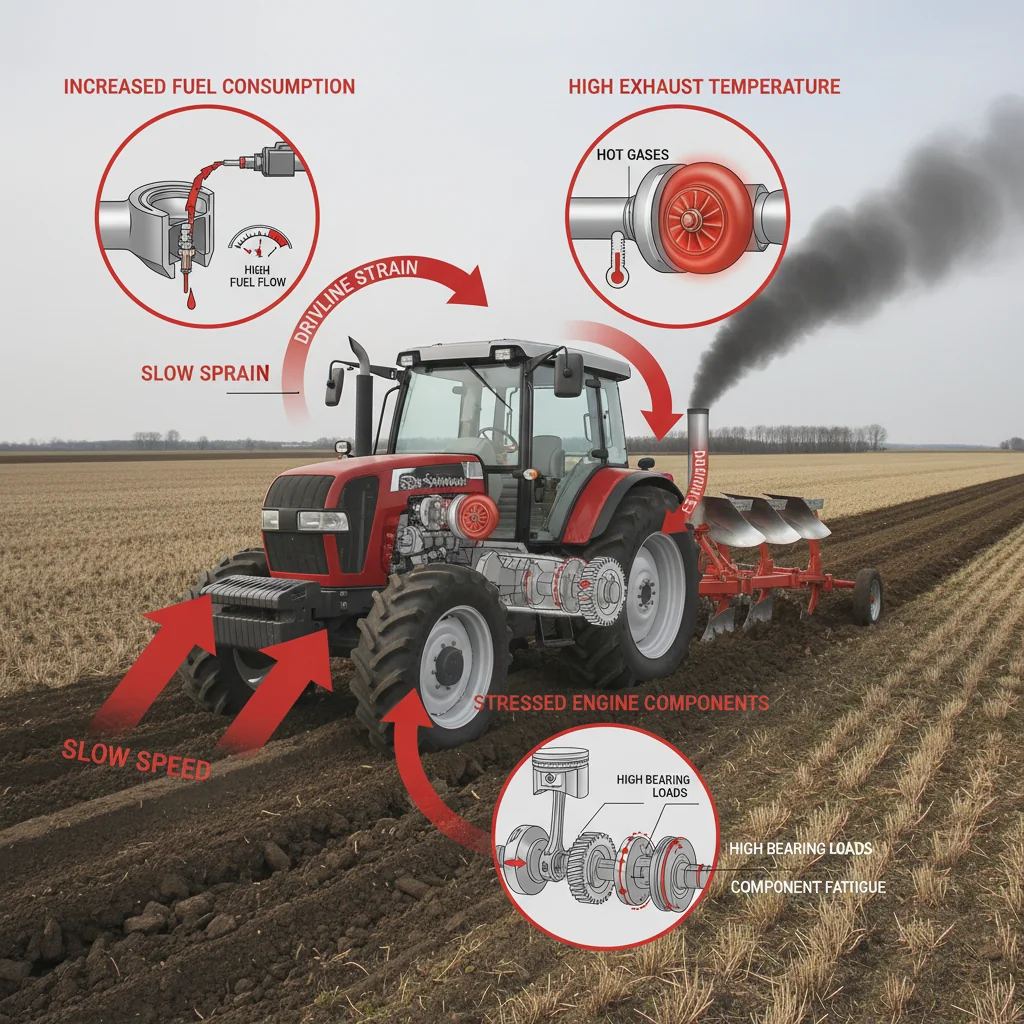
Here's what matters most when matching engine power to tough jobs: the tractor shouldn’t be sweating at its limits all day. I remember a distributor in Bolivia who tried to run 80HP units on heavy-duty ploughing for wheat—fields with stubborn, clay-rich soils. On paper, those tractors had enough horsepower. But in practice, they had to crawl in first or second gear just to avoid stalling. The fuel tank emptied fast, but the real shock was how long it took to finish each hectare. Their operators ended up running 10–12 hours per day just to cover ground that a 100HP tractor would finish in about seven hours.
When a tractor works so close to its maximum load, the engine temperature climbs higher than it should for long periods. That means engine oil breaks down faster—leading to more frequent changes and a real risk of internal wear. I’ve seen clutch plates and final drives wear out after only 2,000 hours in these conditions, when normally you expect at least 4,000 hours before major service. Drivetrain parts like the differential and transmission get stressed too—especially if you’re always shifting between low gears to keep moving. In Kenya, one farm had to replace two rear axles in a single season simply because they pushed a 90HP tractor much too hard.
My honest advice? For regular heavy pulling—primary tillage or deep ripping—choose a model that lets you run at 70–85% of rated power, not flat out. This way, you get lower fuel use, faster work, and your tractor stays reliable for years. I always suggest thinking about real workload, not just engine size on a brochure.
Operating a tractor consistently at or near its maximum engine power leads to higher fuel consumption per hectare and increased engine wear, reducing overall efficiency.True
When a tractor is pushed close to its power limits for long periods, it must work harder to maintain performance, often requiring lower gears and higher RPMs. This not only uses more fuel but also stresses engine components, resulting in more frequent maintenance and downtime.
Selecting a tractor with excessive engine power for the job always guarantees the highest efficiency and lowest fuel usage.False
Oversizing a tractor can lead to inefficient fuel use, as engines running far below their optimal load range may burn more fuel per unit of work. Matching power to the task is essential; too much power can be just as inefficient as too little.
Key takeaway: Running a tractor consistently near its maximum engine load to perform heavy tasks lowers field efficiency, increases fuel consumption per hectare, and accelerates engine and drivetrain wear. Selecting a slightly higher horsepower tractor for demanding jobs helps maintain optimal performance, lower fuel use, and extend machine life.
How to Match Tractor Horsepower to Implements?
Tractor horsepower should be matched to implements based on job requirements and implement type. For example, allow 12–15 hp per 14-inch plough bottom in medium soils, 25–30 hp per meter for rotary tillers7 in heavy conditions, and 1.5–2 hp per kW of PTO-driven equipment8. Over- or under-powering reduces efficiency and increases costs.
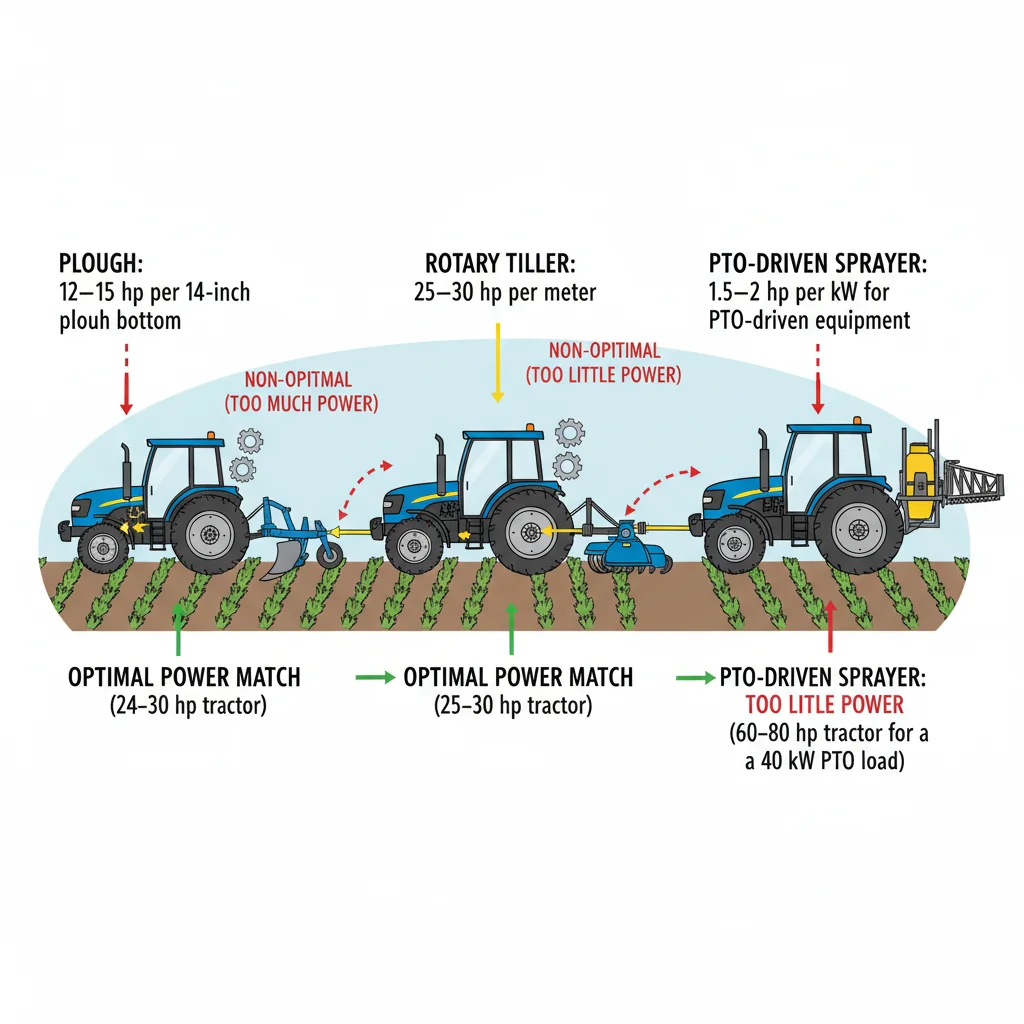
Last month, a contractor in Peru called me frustrated because his 75HP tractor kept bogging down with a 2-meter rotary tiller in clay soils. He’d read that the tractor could handle “up to 2.2 meters,” but the real field conditions told another story. I explained that for heavy soils, rotary tillers often need 25–30 horsepower per meter—so even a 75HP machine is working at its limit with 2 meters. He ended up swapping to a 1.6-meter tiller, and his fuel use dropped while work rate improved. This happens more often than you’d think, especially when buying for mixed soils or hilly regions.
From my experience, matching horsepower is about more than the engine number. Let’s say you’re running a three-bottom plough, each with a 14-inch share, in medium soil. You’ll want at least 36–45HP, not just for pulling but for steady traction and maintaining speed. If you add hills or wetter fields, go higher. For PTO-driven equipment—like choppers or threshers—aim for 1.5 to 2 engine horsepower per kilowatt of implement draw. I’ve seen too many operators in Kenya try to run a 30kW pump on a 45HP tractor, only to stall out during peak demand.
The reality is, both over- and under-powering cost you. Too small a tractor strains the engine, slows the job, and wears out fast. Too large and you’re burning fuel for nothing. I always advise buyers to choose power so their toughest regular implement loads the engine to about 70–85% of rated power. That’s where you get reliability and efficiency, season after season.
Tractor horsepower requirements for implements like rotary tillers can vary significantly depending on soil type, with heavy clay demanding much more power per meter of implement than light sandy soil.True
Heavy soils like clay create greater resistance, forcing the tractor engine to work harder, so the same implement can require far more horsepower in tough conditions compared to lighter soils.
As long as the implement's width does not exceed the tractor’s maximum rated capacity, soil conditions have minimal impact on efficiency and fuel use.False
Soil conditions greatly affect the actual power needed; even if an implement is within the tractor’s rated width, tough soils can overload the tractor, reducing efficiency and increasing fuel consumption.
Key takeaway: Selecting the correct tractor horsepower for each implement is crucial. Aim to load the engine to about 70–85% of its rated power during the heaviest routine operations. Proper matching ensures optimal efficiency, prevents excessive wear, and avoids fuel waste or performance loss.
How Do Torque and PTO Power Impact Efficiency?
Tractor efficiency depends on how torque, PTO horsepower9, and rpm interact during real work. High torque at moderate rpm enables tractors to handle heavy loads and maintain speed under stress, while strong PTO horsepower ensures effective operation of implements. Evaluating torque curves and backup is crucial for consistent field performance, not just rated horsepower.
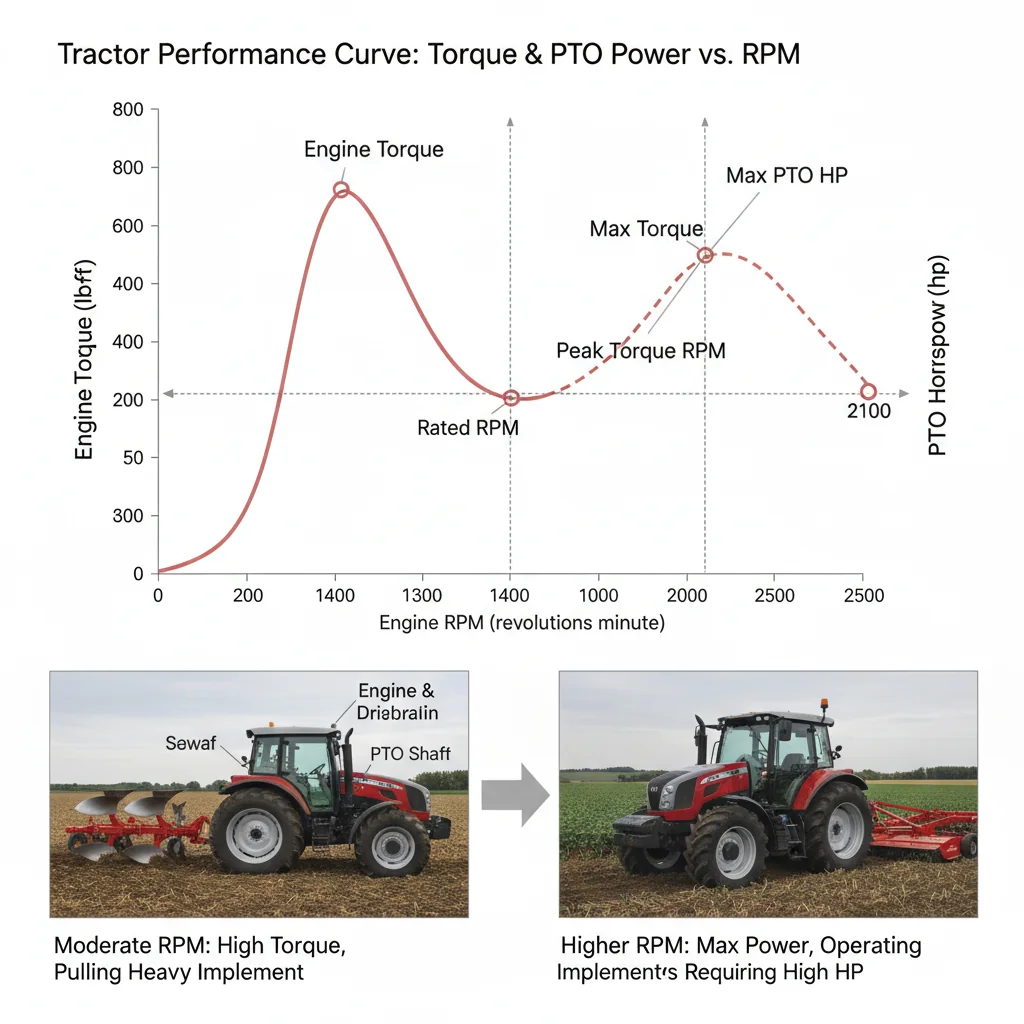
I've worked with customers who made this mistake—choosing a tractor just for its rated horsepower, only to discover it couldn’t keep up during heavy fieldwork. In northern Kazakhstan, one farmer bought a 100HP model hoping it would handle a 2.4-meter disc harrow and a large baler. On paper, it sounded perfect. But in practice, the tractor struggled whenever the soil got wetter or the baler filled up. The issue? Not enough torque and poor PTO horsepower at working rpm. The engine bogged down below 1,800 rpm and the baler sometimes stalled.
Here’s the thing—horsepower is really just torque multiplied by rpm, divided by 5252. What matters in the field is how much torque the engine actually delivers at the rpm where you’re working, usually between 1,600 and 2,000 rpm for most tasks. If your tractor has strong torque and at least 20% torque backup10, it can push through tough spots without losing speed. I’ve seen a 90HP tractor with 80 PTO HP and 25% torque backup outperform a “100HP” model with only 70 PTO HP and 10% backup when pulling a heavy planter in Brazil. The first one kept its rpm steady and didn’t choke at sudden load spikes.
My advice? Always ask for the PTO horsepower and the torque curve, not just the engine’s peak power. Check if torque backup is at least 20%. This makes all the difference for PTO-driven work—like threshers or choppers—especially in tough or variable field conditions. It’s a simple check, but it saves a lot of frustration down the line.
A tractor with high engine horsepower but low PTO horsepower can struggle to efficiently operate heavy implements like balers and disc harrows, especially under load.True
PTO horsepower reflects the usable power delivered to implements, which can be significantly less than the engine's rated horsepower due to drivetrain losses. High engine horsepower alone does not guarantee sufficient implement performance if PTO output is inadequate.
As long as a tractor’s engine horsepower matches the implement’s requirements, torque and PTO power have minimal impact on overall field efficiency.False
Even if engine horsepower seems adequate, insufficient torque and PTO power at working speeds can cause the tractor to bog down or stall during demanding tasks, reducing efficiency and potentially causing equipment damage.
Key takeaway: Rated horsepower alone does not guarantee strong field performance. For reliable efficiency, it is vital to consider PTO horsepower, available torque at working rpm, and torque backup when comparing tractors—especially for PTO-driven tasks or heavy pulling in variable conditions.
Why Do Ballast and Traction Affect Efficiency?
Engine power is only effective if transmitted to the ground. Insufficient tractor weight leads to excessive wheel slip11, wasted fuel, and safety risks. For heavy draft work, maintain 7–8 hp per 100 kg, with proper ballast and tire selection to achieve 8–15% wheel slip and minimize drawbar losses.
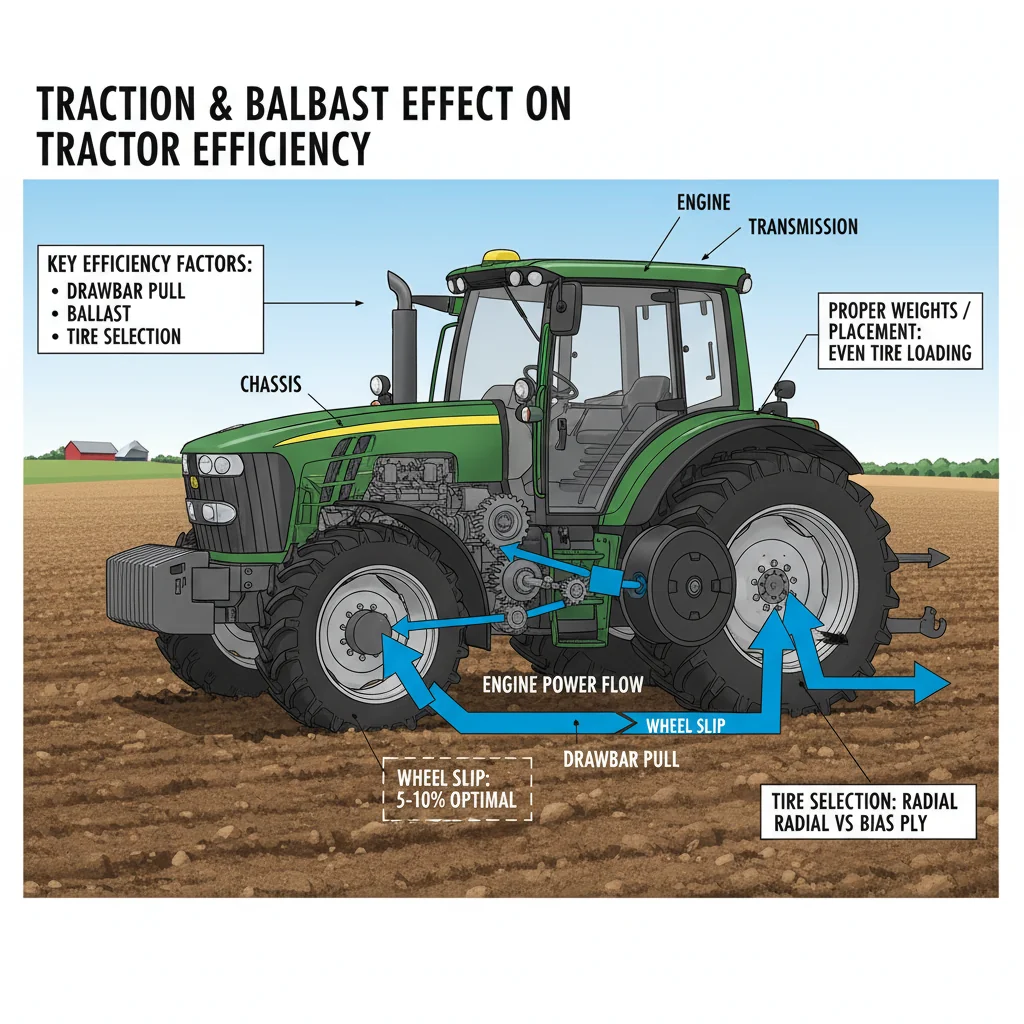
To be honest, the spec that actually matters is how well your tractor’s power reaches the ground. I’ve seen too many buyers in Brazil and Kenya focus on engine horsepower, thinking bigger is always better. But if your tractor is too light for its power, you’ll end up watching the wheels spin and burning through fuel. Last year, a farmer in Mato Grosso called me after his new 120HP tractor struggled with deep tillage. The issue? It weighed under 4 tonnes with no added ballast—he saw wheel slip over 20% and wasted diesel every pass.
The reality is, engine power only works if you’ve got enough weight and the right tires to grab the soil. For heavy pulling, I recommend keeping the power-to-weight ratio12 around 7 to 8 horsepower per 100 kilograms. That means a 100HP tractor should weigh close to 4.5 to 5 tonnes when fully loaded. Add ballast—usually 5–8% of total weight up front, 30–40% at the rear—to get the wheel slip down to 8–15%. Too much slip not only wastes fuel but puts real stress on the drivetrain.
From my experience in Kazakhstan, farmers who ignore ballast end up struggling with uneven fields and poor traction. But loading up too much can compact the soil, hurting yields down the line. My advice? Always budget for proper ballast and suitable tires—not just a bigger engine. It’s this balance that keeps operations efficient, safe, and cost-effective, especially when working tough ground or steep slopes.
A tractor with inadequate ballast relative to its horsepower will experience increased wheel slip, causing inefficient fuel use and reduced implement performance, even if it has a powerful engine.True
Without proper ballast, the tractor's tires can lose traction and spin rather than transferring power to the ground, making engine power less useful. This leads to wasted fuel and decreased effectiveness when pulling heavy implements.
Adding ballast to a tractor always increases efficiency, regardless of soil conditions or implement type.False
Excessive or unnecessary ballast can actually reduce efficiency, especially in firm soils or with lighter implements, by increasing soil compaction and rolling resistance, leading to more fuel consumption without improving traction.
Key takeaway: Tractor efficiency depends on balancing engine power with proper ballast and traction. Maintaining recommended power-to-weight ratios and wheel slip minimizes fuel waste and drivetrain stress, while avoiding soil compaction. Proper setup ensures safe, effective operation and protects equipment in demanding field conditions.
How Do Driving Habits Impact Fuel Efficiency?
Operator technique can swing tractor fuel use by 10–30%. Using 'gear up, throttle down13'—higher gear with reduced engine speed—keeps ground speed while cutting fuel use. Modern diesels are most efficient at 1,700–1,900 rpm under 60–80% load, rather than full throttle. Training operators optimizes efficiency and lowers fuel costs.
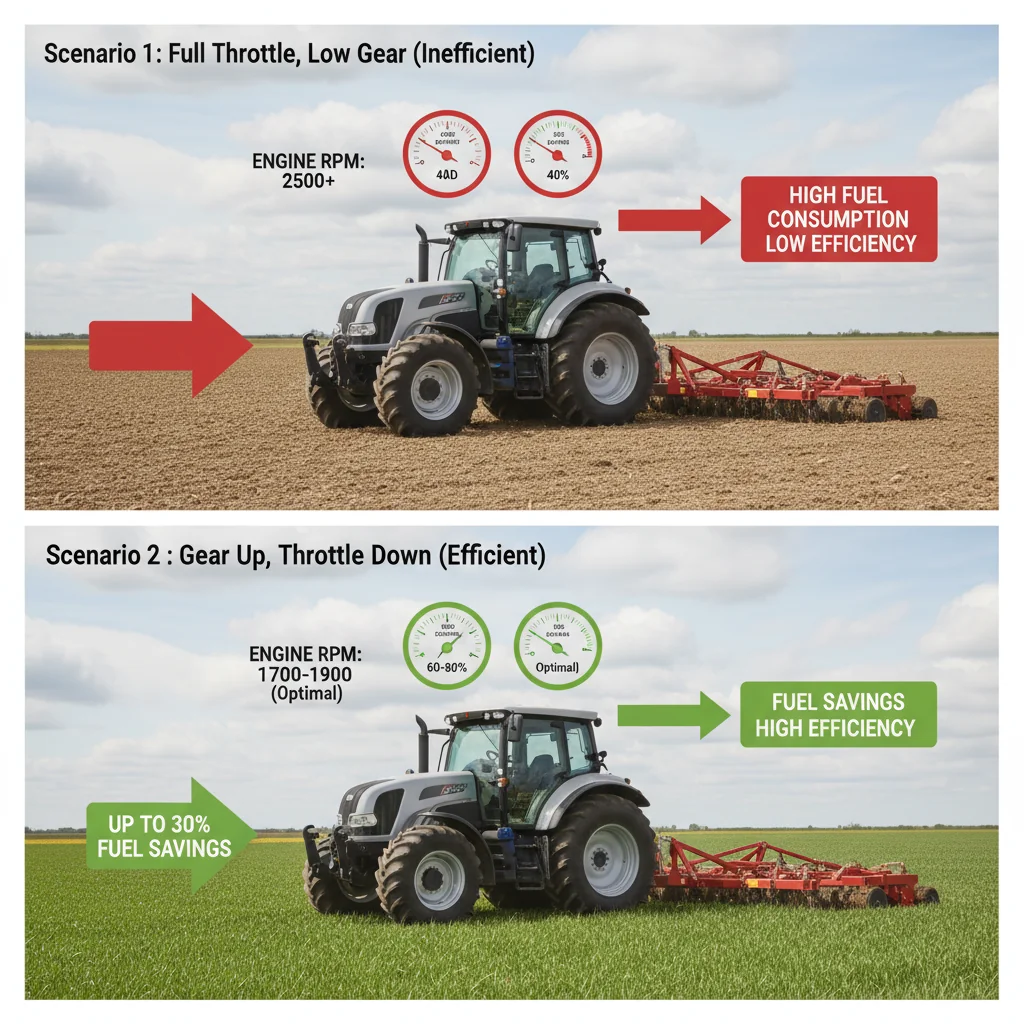
The biggest mistake I see is operators running tractors at full throttle all day, even for light jobs. That habit wastes fuel and wears the engine faster. In many parts of Brazil, I’ve watched farmers plowing light soil with a 90HP tractor at 2,200 rpm—flat out. Most of the time, the engine’s only working at about 60% load. They could save real money by shifting up a gear and reducing the throttle. That’s “gear up, throttle down.” The ground speed stays almost the same, but fuel use drops. I’ve seen savings of at least 10% just by making this change.
From my experience, the sweet spot for most modern diesel tractors is around 1,700 to 1,900 rpm under a moderate load. Operators often worry that lower rpm means less pulling power. The reality is, if the tractor responds quickly to heavier loads and there’s no black smoke—just steady exhaust—it’s in the efficient range. In Kazakhstan, one customer tested this approach during spring tillage. By watching the engine note and exhaust color, he kept his 110HP unit at lower rpm in a higher gear. Over a week, his fuel bill was down by about 12%, and he finished work at the same pace.
Operator training really pays off here. I always suggest running a simple field test: drop the throttle a bit, shift up, and watch how the tractor reacts. If rpm stays steady and the engine sounds happy, you’re running efficiently. If rpm drops or black smoke appears, just shift back down. Small changes save big money over a season.
Operating a tractor at lower rpm with a higher gear for light loads can improve fuel efficiency without sacrificing ground speed.True
Using the 'gear up, throttle down' technique reduces engine speed while maintaining necessary power output, which decreases fuel consumption and engine wear for tasks that don't require full engine power.
Running a tractor at full throttle during all operations ensures optimal fuel efficiency and engine longevity.False
Consistently using full throttle leads to excessive fuel use and faster engine wear, especially when the tractor is not under heavy load. Adjusting rpm and gear selection to match the workload is key to efficient and sustainable operation.
Key takeaway: Operator driving habits significantly influence tractor fuel efficiency, with proper techniques like 'gear up, throttle down' potentially saving 5–15% on fuel. Training to recognize optimal rpm, gear selection, and load response is essential for maximizing efficiency and reducing operational costs in fieldwork.
How Does Engine Load Affect Lifespan?
Engines used predominantly in the mid-load range (50–80% of rated power) experience less wear and longer service life. Persistent light loading can cause wet stacking, cylinder glazing, and oil contamination, while continuous high loading accelerates component stress and oil breakdown, resulting in shorter overhaul intervals and increased maintenance requirements.
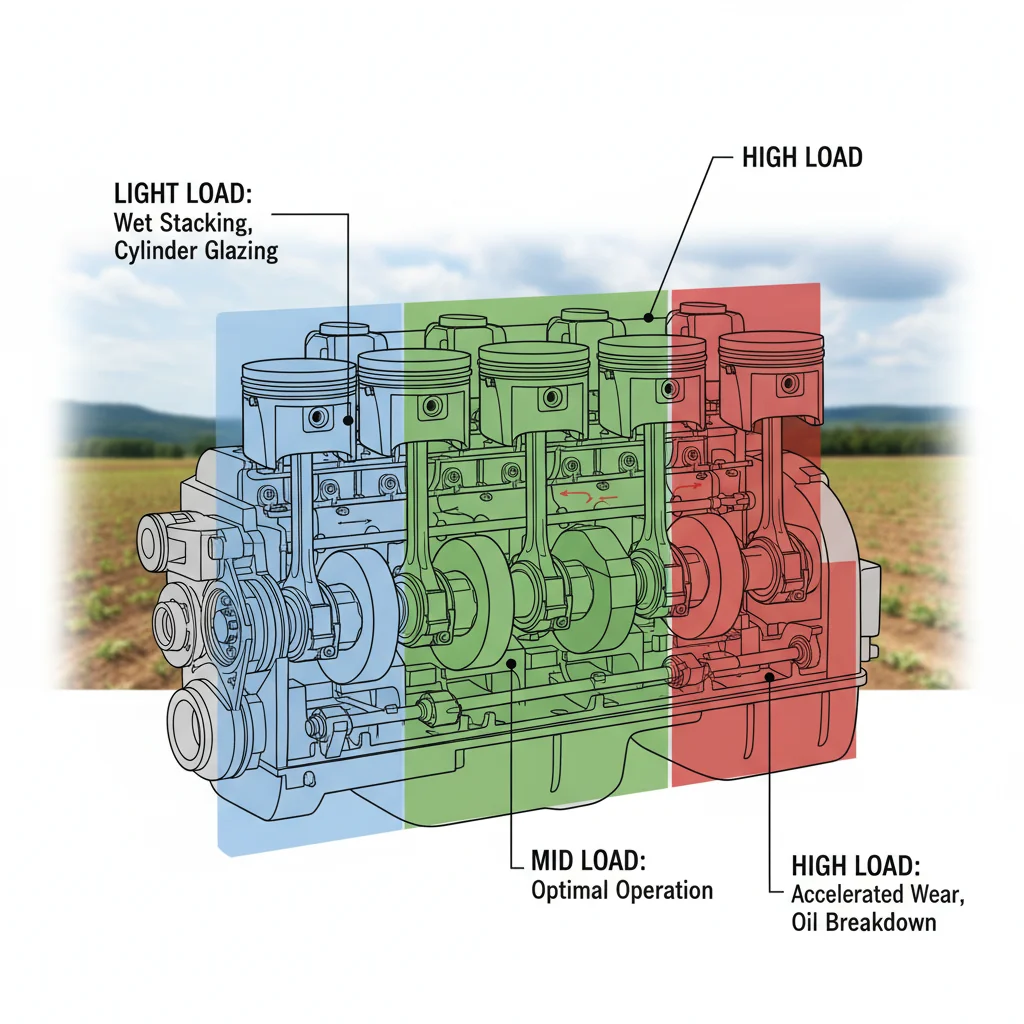
One thing I notice in the field is how many operators underestimate the impact of engine load on their tractor’s health. For example, I once visited a large maize farm in Bolivia where the owner ran a 120HP tractor on light tillage jobs for weeks—barely pushing it past idle. The machine seemed “underworked,” but within six months, they reported issues with black smoke, rough idling, and oil that turned dark much faster than usual. When I checked the injectors and turbo, both showed clear signs of wet stacking—unburnt fuel and soot deposits caused by too many hours below 30% load. The low exhaust temperature couldn’t burn off residue, and the oil was picking up contaminants. That tractor spent more time in the workshop than in the field, just from being “babied.”
On the other side, I’ve seen farmers in Kazakhstan push their 90HP units to the limit every day during spring plowing—sometimes working above 90% of rated power for long stretches. The result? Rising exhaust temperatures, frequent turbo seal failures, and oil that broke down well before the next service. One operator told me he was surprised to find piston ring wear after only 1,500 hours—usually, those engines last much longer. Running hard every day might get the job done faster, but it shortens the time between overhauls and increases repair costs.
I always recommend matching tractor size to your main jobs so you can stay in that 50–80% load range most of the time. Balanced loading means less stress, cleaner oil, and fewer surprises at service time. That’s how you get the most value from your machine.
Consistently running a tractor engine at loads well below its optimal operating range can lead to incomplete fuel combustion, which accelerates carbon buildup on injectors and turbochargers.True
Modern diesel engines are designed to operate efficiently within a specific load range, typically around 60-80% of rated capacity. Prolonged light loading leads to lower combustion temperatures, causing unburned fuel and soot to accumulate in critical components, reducing efficiency and lifespan.
Operating a tractor at maximum engine load at all times is the best way to extend its engine lifespan.False
While underloading causes issues, consistently running an engine at maximum load increases thermal and mechanical stress, leading to accelerated wear of engine components. Optimal engine life is achieved by maintaining moderate, balanced loads rather than consistently running at either extreme.
Key takeaway: Running a tractor engine mainly within its mid-load band optimizes both efficiency and longevity. Avoiding both persistent light and sustained heavy loads helps prevent common engine problems, reduces maintenance frequency, and lowers long-term repair costs for reliable operation in demanding agricultural conditions.
Conclusion
We looked at how matching engine power to your farm’s main tasks helps you get better fuel efficiency and longer engine life. From what I’ve seen, the best results come when you size the tractor for your heaviest job—not just for price or max horsepower. Too much power can waste fuel; too little leads to overwork and breakdowns. Before you decide, I suggest checking the three-point hitch capacity and making sure spare parts are easy to source locally. Have questions about specs, attachments, or which model fits your needs? I’m happy to share what’s worked for farmers in different regions—feel free to reach out. Every farm is different—choose what actually works for your needs.
References
-
Analyzes the impact of running tractors below 40% load on fuel efficiency and long-term expenses for farmers. ↩
-
Understand why running tractors at 60–80% of rated power maximizes fuel economy and reduces engine wear in modern diesel engines. ↩
-
Explore how operating tractors within the optimal load band improves fuel efficiency and engine longevity with real field data insights. ↩
-
Explore how matching tractor horsepower with implement size reduces fuel use per hectare, improving field efficiency and cutting costs. ↩
-
Learn how increasing field capacity with wider implements or faster speeds enhances tractor productivity and lowers fuel consumption. ↩
-
Explores how buying extra horsepower raises fuel and maintenance costs, reducing tractor efficiency and profitability. ↩
-
Detailed guidance on selecting the right tractor horsepower for rotary tillers to improve efficiency and reduce fuel costs in tough soil conditions. ↩
-
Expert advice on calculating tractor horsepower requirements for PTO-driven implements to avoid stalling and maximize performance. ↩
-
Details the role of PTO horsepower in powering implements effectively, crucial for optimizing tractor and implement performance. ↩
-
Explains how torque backup helps tractors maintain speed and power under heavy loads, ensuring reliable fieldwork efficiency. ↩
-
Detailed insights on how wheel slip affects fuel efficiency and traction, plus practical tips to reduce slip for better performance. ↩
-
Explains the critical balance between tractor weight and horsepower to optimize traction, reduce fuel waste, and improve safety. ↩
-
Explains how shifting to a higher gear with lower engine speed reduces fuel consumption by up to 30%, saving costs and engine wear. ↩